

Stupid Hot Pork Rinds - 3 oz
Pork King Good
$4.99
(No reviews yet)

Write a Review
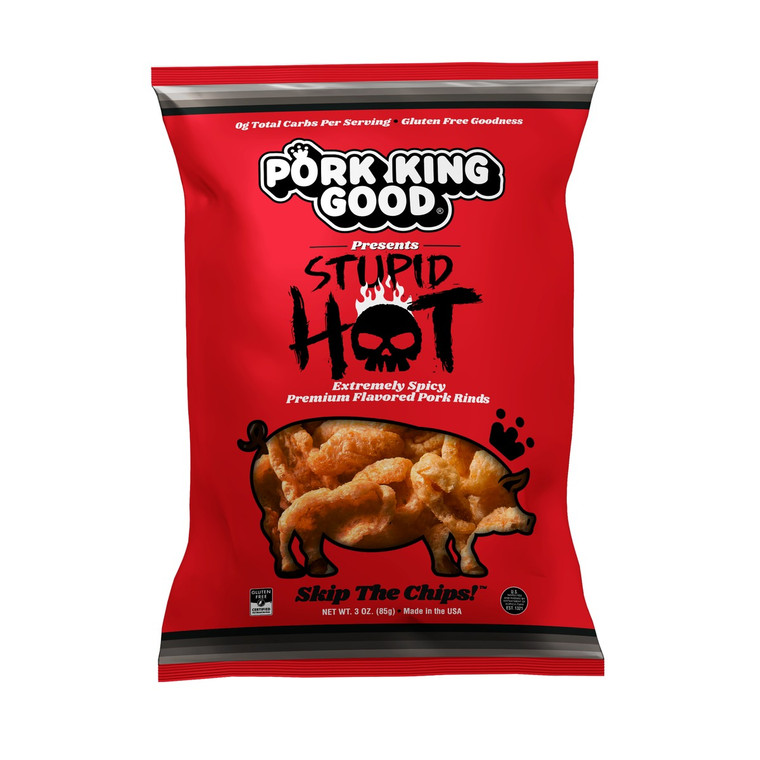
Pork King Good
Stupid Hot Pork Rinds - 3 oz
Stupid Hot is not a dare — it's a number. These chicharrones carry a 250,000 Scoville jalapeño heat load, rendered and fried in-house at the Milwaukee plant Pork King Good's founder bought outright in 2022, becoming the only woman-owned pork rind manufacturer in the country. The Try Guys tested them on camera and did not finish the bag casually.
- Built for serious dipping — sour cream, onion dip, or anything that needs to fight back against the heat
- Fried in their own rendered pork fat at the same Wisconsin facility that's made chicharrones for generations, with spice extractives and dehydrated jalapeño doing the work instead of artificial heat
- 0 carbs per serving, keto and paleo compliant, gluten free, from a woman-owned manufacturer
Pork King Good didn't set out to make the world's hottest pork rind — they just kept turning up the jalapeño until The Try Guys put it in a YouTube taste test and visibly regretted it. That's Stupid Hot: 250,000 Scoville heat units of dehydrated jalapeño and spice extractives, built on rinds cooked in their own rendered pork fat at the 74-year-old Milwaukee manufacturing plant Pork King Good acquired in 2022, making it the only woman-owned pork rind manufacturer in the country.
Each 3 oz bag of these spicy chicharrones delivers 80 calories and 0 carbs per serving, with the crackling texture that comes from fat-frying rather than baking. No fillers, no artificial flavors — the heat comes from real jalapeño and spice, not a lab.
Serve it the way it's meant to be handled: with something cool to cut the burn. Sour cream dip and French onion dip are the standard pairing, and this flavor holds its own on a snack board next to milder chips for people who want to test their limits.
Keto, paleo, and gluten-free by nature, with no MSG and no artificial ingredients, colors, or flavors. Store in a cool, dry pantry — no refrigeration required.
Ingredients: Pork Rinds (Cooked In Pork Fat), Salt, Spices, Jalapeno Dehydrated, Sodium Diacetate, and Spice Extractives.
Common Questions
How does the nutrition profile compare to a regular bag of spicy potato chips?
A 3 oz bag of Stupid Hot delivers roughly 80 calories and 0 carbs per serving, with the bulk of calories coming from protein and rendered pork fat rather than starch. A comparable serving of jalapeno-flavored potato chips typically runs 150-160 calories and 15-16 grams of carbohydrate from potato starch, plus added sugars in some seasoning blends. The pork rind also delivers around 9 grams of protein per serving, something potato-based chips carry almost none of. So gram for gram, you're getting a higher protein, zero-carb snack instead of a starch-and-oil one.
Where does the 250,000 Scoville heat rating actually come from?
The heat is built from two ingredients working together: dehydrated jalapeno, which naturally contains capsaicin (the compound responsible for the burning sensation on pain receptors), and spice extractives, which are concentrated capsaicinoid extracts used to push the heat level well past what fresh jalapeno alone provides. Fresh jalapenos typically measure 2,500 to 8,000 Scoville Heat Units, so reaching 250,000 SHU requires that concentrated extractive addition rather than jalapeno alone. Sodium diacetate is included as a shelf-stable acidifier and mold inhibitor, not a heat contributor. There's no synthetic capsaicin substitute here — the burn comes from real pepper compounds at a concentrated dose.
Does this fit a strict keto, paleo, or carnivore protocol?
Yes, on all three counts. At 0 carbs per serving there's no net-carb math required for keto tracking, and the fat-to-protein ratio (roughly 80 calories split between fat and 9 grams of protein) fits standard keto macros without adjustment. For paleo, the ingredient list avoids grains, legumes, and refined sugar, meeting the whole-food-only standard most paleo protocols require. Strict carnivore eaters will want to check the spice and jalapeno content against their own plant-elimination rules, since those are plant-derived ingredients, but for keto and paleo followers this is a straightforward fit with no hidden carb sources.
What are some ways to work this into a meal beyond snacking straight from the bag?
Because the heat is aggressive, most people pair it with something cooling rather than eating it solo for long stretches — sour cream dip and French onion dip are the standard call, and a cold beer or milk works for the same reason. It also holds up well as a garnish on a Bloody Mary, alongside deviled eggs on a brunch spread, or as one hot option on a snack board next to milder flavors so guests can choose their own heat level. As a chili or loaded-nacho topping it adds crunch and capsaicin heat without introducing any carbs to the dish. No cooking adaptation is needed since it's fully cooked and shelf-stable as is.
What do the keto, paleo, and gluten-free labels on this bag actually verify?
The gluten-free designation confirms there's no wheat, barley, or rye derivative anywhere in the ingredient list — the entire product is pork rinds, salt, spices, dehydrated jalapeno, sodium diacetate, and spice extractives, none of which contain gluten. The keto and paleo callouts reflect the zero-carb, no-added-sugar, no-grain composition rather than a third-party certifying body stamp, so the way to verify it yourself is simply reading the seven-ingredient list on the bag, which is short enough to check in a few seconds. The 'no artificial ingredients, colors, or flavors' claim means the jalapeno heat and color come from the dehydrated pepper and spice extractives themselves, not from an added dye or lab-created flavor compound. There's no MSG anywhere in the formulation either.
What does 'woman-owned pork rind manufacturer' mean here, and why does it matter?
Pork King Good acquired a Milwaukee manufacturing plant with a 74-year production history in 2022, and that acquisition made them the only woman-owned pork rind manufacturer in the United States. That's a distinction about who owns and runs the physical production facility, not just who owns the brand name on the bag — most pork rind labels on shelves are co-packed through third-party manufacturers rather than owned outright. The plant's decades of prior production experience carried over into how the rinds are fried in their own rendered pork fat rather than baked, which is what gives the finished product its crackling texture.
Why fry in pork fat instead of baking or using a different oil?
Frying in rendered pork fat is the traditional method that produces the light, crackling texture pork rinds are known for, as opposed to the denser, harder texture that comes from oven-baking or air-frying alternatives. The fat itself becomes part of the flavor base, which is one reason the ingredient list stays short — pork rinds cooked in pork fat, salt, spices, dehydrated jalapeno, sodium diacetate, and spice extractives, with nothing added to compensate for a blander cooking method. This is also the same process used at the Milwaukee plant across its multi-decade production history, so it's a continuation of an established technique rather than a new shortcut.
Each 3 oz bag of these spicy chicharrones delivers 80 calories and 0 carbs per serving, with the crackling texture that comes from fat-frying rather than baking. No fillers, no artificial flavors — the heat comes from real jalapeño and spice, not a lab.
Serve it the way it's meant to be handled: with something cool to cut the burn. Sour cream dip and French onion dip are the standard pairing, and this flavor holds its own on a snack board next to milder chips for people who want to test their limits.
Keto, paleo, and gluten-free by nature, with no MSG and no artificial ingredients, colors, or flavors. Store in a cool, dry pantry — no refrigeration required.
Ingredients: Pork Rinds (Cooked In Pork Fat), Salt, Spices, Jalapeno Dehydrated, Sodium Diacetate, and Spice Extractives.
Common Questions
How does the nutrition profile compare to a regular bag of spicy potato chips?
A 3 oz bag of Stupid Hot delivers roughly 80 calories and 0 carbs per serving, with the bulk of calories coming from protein and rendered pork fat rather than starch. A comparable serving of jalapeno-flavored potato chips typically runs 150-160 calories and 15-16 grams of carbohydrate from potato starch, plus added sugars in some seasoning blends. The pork rind also delivers around 9 grams of protein per serving, something potato-based chips carry almost none of. So gram for gram, you're getting a higher protein, zero-carb snack instead of a starch-and-oil one.
Where does the 250,000 Scoville heat rating actually come from?
The heat is built from two ingredients working together: dehydrated jalapeno, which naturally contains capsaicin (the compound responsible for the burning sensation on pain receptors), and spice extractives, which are concentrated capsaicinoid extracts used to push the heat level well past what fresh jalapeno alone provides. Fresh jalapenos typically measure 2,500 to 8,000 Scoville Heat Units, so reaching 250,000 SHU requires that concentrated extractive addition rather than jalapeno alone. Sodium diacetate is included as a shelf-stable acidifier and mold inhibitor, not a heat contributor. There's no synthetic capsaicin substitute here — the burn comes from real pepper compounds at a concentrated dose.
Does this fit a strict keto, paleo, or carnivore protocol?
Yes, on all three counts. At 0 carbs per serving there's no net-carb math required for keto tracking, and the fat-to-protein ratio (roughly 80 calories split between fat and 9 grams of protein) fits standard keto macros without adjustment. For paleo, the ingredient list avoids grains, legumes, and refined sugar, meeting the whole-food-only standard most paleo protocols require. Strict carnivore eaters will want to check the spice and jalapeno content against their own plant-elimination rules, since those are plant-derived ingredients, but for keto and paleo followers this is a straightforward fit with no hidden carb sources.
What are some ways to work this into a meal beyond snacking straight from the bag?
Because the heat is aggressive, most people pair it with something cooling rather than eating it solo for long stretches — sour cream dip and French onion dip are the standard call, and a cold beer or milk works for the same reason. It also holds up well as a garnish on a Bloody Mary, alongside deviled eggs on a brunch spread, or as one hot option on a snack board next to milder flavors so guests can choose their own heat level. As a chili or loaded-nacho topping it adds crunch and capsaicin heat without introducing any carbs to the dish. No cooking adaptation is needed since it's fully cooked and shelf-stable as is.
What do the keto, paleo, and gluten-free labels on this bag actually verify?
The gluten-free designation confirms there's no wheat, barley, or rye derivative anywhere in the ingredient list — the entire product is pork rinds, salt, spices, dehydrated jalapeno, sodium diacetate, and spice extractives, none of which contain gluten. The keto and paleo callouts reflect the zero-carb, no-added-sugar, no-grain composition rather than a third-party certifying body stamp, so the way to verify it yourself is simply reading the seven-ingredient list on the bag, which is short enough to check in a few seconds. The 'no artificial ingredients, colors, or flavors' claim means the jalapeno heat and color come from the dehydrated pepper and spice extractives themselves, not from an added dye or lab-created flavor compound. There's no MSG anywhere in the formulation either.
What does 'woman-owned pork rind manufacturer' mean here, and why does it matter?
Pork King Good acquired a Milwaukee manufacturing plant with a 74-year production history in 2022, and that acquisition made them the only woman-owned pork rind manufacturer in the United States. That's a distinction about who owns and runs the physical production facility, not just who owns the brand name on the bag — most pork rind labels on shelves are co-packed through third-party manufacturers rather than owned outright. The plant's decades of prior production experience carried over into how the rinds are fried in their own rendered pork fat rather than baked, which is what gives the finished product its crackling texture.
Why fry in pork fat instead of baking or using a different oil?
Frying in rendered pork fat is the traditional method that produces the light, crackling texture pork rinds are known for, as opposed to the denser, harder texture that comes from oven-baking or air-frying alternatives. The fat itself becomes part of the flavor base, which is one reason the ingredient list stays short — pork rinds cooked in pork fat, salt, spices, dehydrated jalapeno, sodium diacetate, and spice extractives, with nothing added to compensate for a blander cooking method. This is also the same process used at the Milwaukee plant across its multi-decade production history, so it's a continuation of an established technique rather than a new shortcut.
- __Storage_Location:
- Dry
- __Volume:
- 400
- __Owner:
- Pork King Good
- __badge:
- Keto