

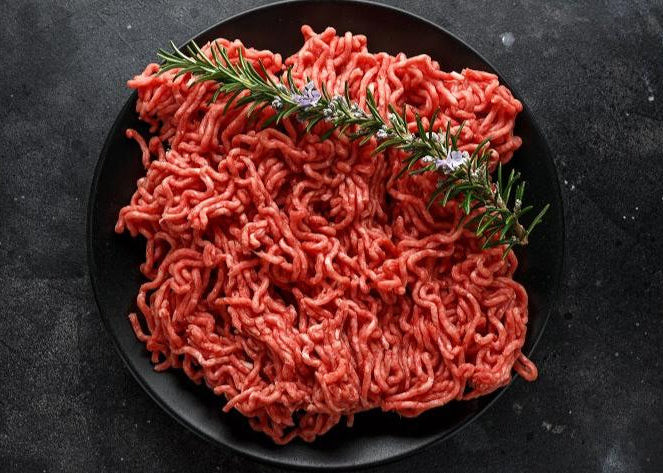
Ground Beef - 1 lb
Northstar BisonBelow are the available bulk discount rates for each individual item when you purchase a certain amount
- Buy 6 - 11 and get 4% off
- Buy 12 - 23 and get 8% off
- Buy 24 or above and get 12% off
Write a Review
Northstar Bison
Ground Beef - 1 lb
85% lean, 100% Grass-Fed and Finished; the ground beef you keep stocked and reach for every night. Sourced from small family farms in Wisconsin and ground in small batches at Northstar Bison's own facility in Cameron, WI, this beef is never overheated, never rushed, and never touched by flavor enhancers, colorings, or preserving agents. Regeneratively raised. Hormone-free. Antibiotic-free. Non-GMO. Hand delivered to your door by local drivers.
- Burgers, Bolognese, tacos, patty melts, chili — the 85/15 ratio gives you enough fat for structure and flavor without excess grease
- 100% Grass-Fed and Finished on diverse Wisconsin pastures — never transitioned to grain — small-batch ground in a single owned facility with zero additives
- Keto, paleo, carnivore, gluten-free, grain-free, corn-free, and soy-free
85% lean and uncompromised; this is the grass-fed ground beef you keep in the freezer and reach for without thinking twice.
Sourced from small family farms in Wisconsin, this beef is 100% Grass-Fed and Finished — meaning the animals graze on diverse, lush cool-season pastures from birth to harvest, never transitioned to grain. Northstar Bison harvests humanely, then grinds in small batches at their own processing facility in Cameron, WI. The result: clean, honest 85/15 ground beef with none of the shortcuts — no flavor enhancers, no colorings, no preserving agents of any kind. Regeneratively raised. Non-GMO. Hormone-free. Antibiotic-free. 1 lb per package.
Most ground beef at the grocery store is grain-finished, processed in large industrial facilities, and may contain added colorings or preservative agents to extend shelf life and standardize color. This beef is different at every step: grass-fed and finished on Wisconsin family farms, small-batch ground in a single owned facility, and completely free of any additive. You're getting the meat — nothing masked, nothing extended, nothing added.
Grass-fed and finished beef carries a different fat profile than grain-finished. The forage quality, breed selection, and regenerative grazing management Northstar Bison uses contribute to beef that is more nutrient-dense than its grain-finished counterpart. At 85% lean, there's enough fat to cook with confidence — burgers hold together, Bolognese has body, tacos have real flavor — without excess grease.
Burgers, Bolognese, tacos, patty melts, chili, meatballs — this is the workhorse cut. The 85/15 lean-to-fat ratio makes it one of the most versatile formats in the lineup: enough structure to form patties, enough fat to carry a sauce. Fits keto, paleo, carnivore, gluten-free, grain-free, corn-free, and soy-free eating — reliable whether you're tracking macros or simply prioritizing whole-food ingredients.
Customers who've tried it put it plainly: "SO flavorful. And so reassuringly clean and healthy." Many keep it as a daily staple — and it shows in the repeat orders.
- "Very impressed with the consistently excellent quality of this brand's wonderful offerings. SO flavorful. And so reassuringly clean and healthy." — Sean S., Verified Buyer
- "The quality cannot be beat! I highly recommend it!" — Linda F., Verified Buyer
- "We love the ground beef, we use it almost daily for our dinners." — Sheila D., Verified Buyer
Packaged and delivered frozen. Freezer: up to 24 months. Refrigerator: 5–7 days after thawing. Thaw time: 24 hours in the refrigerator. Hand delivered to your door by local drivers.
Ingredients: 100% Grass-Fed and Finished Ground Beef.
Common Questions
How does this ground beef compare nutritionally to conventional grain-finished ground beef?
At the same 85/15 lean-to-fat ratio, grass-fed and finished ground beef contains meaningfully different fat composition than grain-finished equivalents. Research published in Nutrition Journal found that grass-fed beef contains roughly 2–5 times more omega-3 fatty acids (primarily ALA, with some EPA and DHA) compared to grain-finished beef, as well as 2–3 times higher levels of conjugated linoleic acid (CLA). CLA is a naturally occurring fatty acid associated in research with reduced body fat accumulation and immune support. The overall omega-6 to omega-3 ratio in grass-fed beef is typically around 1.5:1 to 3:1, compared to 7:1 or higher in grain-finished beef — a ratio nutritionists generally consider more favorable for reducing systemic inflammation. For standard macros, an 85/15 ground beef serving of 4 oz (113g) provides approximately 21g protein, 17g fat, and 240–245 calories, regardless of how the animal was raised — the difference is in the fat quality, not the gross calorie count.
What does 'grass-fed and finished' actually mean, and why does the 'finished' part matter?
In the United States, USDA and FSIS labeling guidance requires that beef labeled 'grass-fed' must be fed only forage — no grain or grain by-products — from weaning through harvest, with continuous pasture access during the growing season. Despite that standard, enforcement and interpretation have historically varied, and consumer confusion persists because some products marketed as 'grass-fed' may have received grain at some stage. The finishing period matters enormously because it is the final phase of feeding that largely determines the animal's fat composition at slaughter. An animal grain-finished for even 90 days can lose much of the elevated omega-3 and CLA content it built on pasture, reverting its fat profile closer to conventional grain-finished beef. 'Grass-fed and finished' means the animal grazed exclusively on forage — pasture grasses, legumes, and other forage — from birth through harvest, with no grain at any stage. Northstar Bison's cattle graze on diverse cool-season pastures in Wisconsin, and the beef is harvested without a grain transition. This is what makes the fat profile distinct from many 'grass-fed' products in the marketplace that may not have maintained a forage-only diet through the entire finishing period.
Does 85/15 ground beef fit keto, paleo, and carnivore macros?
Yes, with no modification needed. For a standard 4 oz (113g) serving, 85/15 ground beef provides approximately 21g protein, 17g fat, 0g carbohydrates, and roughly 240–245 calories. The zero-carb profile makes it compatible with strict ketogenic targets, where most protocols call for fat at 60–75% of calories and protein at 20–30% — a single serving of this beef contributes roughly 65% of its calories from fat, fitting cleanly within that range. Paleo and carnivore protocols are similarly straightforward: the ingredient list is exactly one item (100% grass-fed and finished ground beef), with no fillers, binders, flavor enhancers, colorings, or preserving agents that would disqualify it under either framework. For carnivore specifically, the grass-fed and finished fat profile is considered important by many practitioners because of its higher CLA and omega-3 content relative to grain-finished alternatives.
Can I substitute this for conventional ground beef in recipes, and do I need to adjust anything when cooking it?
This beef substitutes directly into any recipe calling for 80/20 or 85/15 ground beef — burgers, Bolognese, chili, meatballs, tacos, meat sauce, stuffed peppers, shepherd's pie, patty melts, and similar applications all work without modification. One practical note: grass-fed beef has slightly less intramuscular fat marbling than grain-finished beef at the same lean percentage, and the fat has a slightly different melting point due to its higher polyunsaturated fatty acid content. In practice, this means it can reach its ideal internal temperature a bit faster on high heat. For burgers, the USDA minimum safe internal temperature for ground beef is 160°F — use a thermometer rather than relying on color, as grass-fed beef can brown faster than grain-finished. For ground applications like Bolognese or meat sauce where you're building a braise, no adjustment is needed at all — the 85/15 ratio provides enough fat to develop flavor without excess grease pooling. For meatballs or meat loaf where the mix is combined with binders, behavior is identical to conventional 85/15.
What specific compounds in grass-fed beef are responsible for the claimed nutritional benefits?
The two most researched compounds that differentiate grass-fed and finished beef are conjugated linoleic acid (CLA) and long-chain omega-3 fatty acids. CLA is a naturally occurring trans fatty acid (not the industrially produced trans fat associated with health risks) found at levels approximately 2–3 times higher in grass-fed beef than grain-finished, according to multiple peer-reviewed reviews. CLA has been studied for its associations with reduced adipogenesis, improved insulin sensitivity, and anti-tumor activity in animal models. The omega-3 fatty acids in grass-fed beef are primarily alpha-linolenic acid (ALA), with smaller but measurable amounts of EPA and DHA — the same long-chain forms found in fatty fish — which are essentially absent in grain-finished beef. Additionally, grass-fed beef typically shows higher concentrations of beta-carotene (the precursor to vitamin A) and vitamin E (alpha-tocopherol), both of which function as antioxidants. These differences are directly attributable to the carotenoid and fatty acid content of the pasture forage the animals consume.
How can I verify that this beef is actually what it claims to be — grass-fed, hormone-free, antibiotic-free, and non-GMO?
Northstar Bison raises and processes this beef within a vertically integrated supply chain: the cattle are sourced from small family farms in Wisconsin, and the beef is ground in small batches at Northstar Bison's own processing facility in Cameron, WI. This single-facility processing is a meaningful distinction — most ground beef sold in grocery stores is aggregated from multiple sources and processed in large regional plants, making traceability significantly harder. The 100% grass-fed and finished claim is verifiable through Northstar Bison's farm relationships, which are named and regional rather than anonymous commodity sourcing. Hormone-free means no synthetic growth hormones (such as estradiol, progesterone, testosterone, zeranol, melengestrol acetate, or trenbolone acetate) were administered — these are the six hormones approved by the FDA for use in beef cattle, none of which were used here. Antibiotic-free means no antibiotics were administered at any point in the animal's life, not merely a withdrawal period before harvest. Non-GMO refers to no genetically modified organisms in feed — relevant here primarily as confirmation that supplemental feed or forage seed used on these farms is non-GMO, consistent with a pasture-only protocol.
What makes small-batch processing at a single facility different from how most ground beef is made?
The majority of ground beef sold in the United States is produced by large processors who source trim from dozens or hundreds of individual cattle and blend it together before grinding — a practice that makes it routine for a single one-pound package to contain beef from over 100 individual animals, based on USDA documentation of commercial grinding practices. This aggregation is one reason E. coli contamination events can affect millions of pounds of product at once. Northstar Bison grinds in small batches at their own facility in Cameron, WI, using cattle sourced from their own contracted Wisconsin farms. This means the chain of custody is short, the batch size is limited, and there are no third-party aggregators or co-packing facilities adding unknown sources to the grind. The absence of any additives — no flavor enhancers, no colorings, no preserving agents — is only possible in this model because the beef doesn't need to travel through multiple hands or sit on a shelf under fluorescent lights for an extended period before reaching a consumer. The ingredient list containing exactly one item is a direct result of that processing structure.
- __Storage_Location:
- Frozen
- __Volume:
- 600
- __badge:
- Grass-Fed Finished
- __Owner:
- NorthStar