

Bison Feast Canned Cat Food - 8 oz
Northstar BisonBelow are the available bulk discount rates for each individual item when you purchase a certain amount
- Buy 6 - 11 and get 4% off
- Buy 12 - 23 and get 8% off
- Buy 24 or above and get 12% off
Write a Review
Northstar Bison
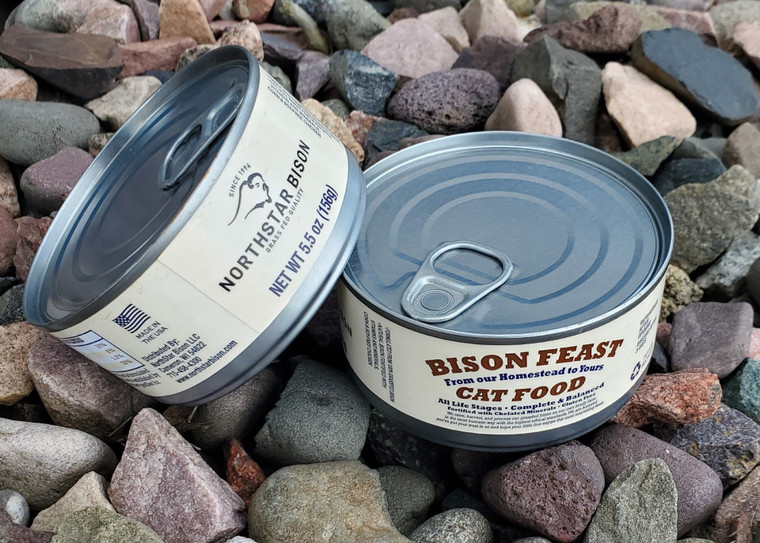
Bison Feast Canned Cat Food - 8 oz
Whole-animal bison — meat, organs, and tripe — in a clean, convenient, shelf-stable form your cat will be at your feet for. Northstar's Bison Feast Cat Food is built from 100% grass-fed and finished Northern Plains bison: muscle meat, liver, heart, tripe, and trachea, plus pastured chicken carcass for calcium. No corn, no soy, no grains, no fillers, no artificial colors or preservatives — fortified with vitamins and minerals for a complete adult diet. Grain-free, gluten-free, and ready to serve straight from the can. Hand delivered to your door by local drivers.
- Whole-prey ingredient profile — bison meat, liver, heart, tripe, and trachea — in a convenient peel-lid can; no prep, no freezer required
- 100% grass-fed and finished Northern Plains bison — not grain-finished, not feedlot, not mystery meat meal — every ingredient is identifiable
- Grain-free, gluten-free, corn-free, and soy-free — a clean fit for carnivore-style, ancestral, or rotation feeding alongside raw or frozen diets
Northstar's Bison Feast Canned Cat Food starts with a simple question: what would a wild cat actually eat? The answer is in the can — bison muscle meat, liver, heart, tripe, and trachea from 100% grass-fed and finished Northern Plains bison, plus pastured chicken carcass for calcium. That's whole-animal nutrition in a shelf-stable, peel-lid can. No freezer. No prep. Guaranteed analysis per 5.5 oz can (156g): Protein (min.) 10% — Fat (min.) 6% — Fiber (min.) 1.5% — Moisture (max.) 78%.
Northstar pressure-cooks at low heat and low pressure — just enough to make the canning process food-safe — preserving the nutritional integrity of those whole-food ingredients rather than cooking them off. The result is a complete adult diet that smells clean, feeds clean, and holds shelf-stable at room temperature without any artificial preservatives to get it there.
Pick up a can of conventional cat food and read the back panel. You'll find corn, soy, wheat, or generic "meat meal" listed before anything identifiable. Northstar's formula leads with bison — sourced from the Northern Plains, grass-fed and finished, never grain-finished — followed by the specific organs and a single whole-food calcium source. No mystery proteins, no grain fillers, no synthetic flavor enhancers to make a substandard base palatable. This is what a complete diet looks like when the ingredient list doesn't need to hide anything.
Feeding guide: 1 oz per lb of body weight per day. Formula is grain-free, gluten-free, corn-free, and soy-free — a clean fit for carnivore-style, ancestral whole-prey, or rotation feeding. Works seamlessly alongside frozen or raw diets, and shelf-stable enough to travel or stock up without freezer space.
Customers who've made the switch report cats finishing the bowl clean and staying at their feet for more — and several have noted visible health improvements after moving away from conventional formulas. A few things they've said:
- "Nice healthy for my cat safe food. As we all know, safe is getting extremely hard to find. So thank you NorthStar for supplying us with safe for our [cats]." — Gwen S., Verified Buyer
- "Our cats also like the home cooked ground bison I have shipped from [Northstar]." — Mitchell Z., Verified Buyer
Shelf-stable — no refrigeration or freezing required. Store at room temperature; no thaw time needed. Hand delivered to your door by local drivers.
Ingredients: Bison, Water Sufficient for Processing, Bison Bone, Bison Liver, Bison Tripe, Bison Heart, Bison Trachea, Guar Gum, Vitamin E Supplement, Niacinamide, L-Ascorbyl-2-Polyphosphate, Calcium Pantothenate, Thiamine Mononitrate, Vitamin A Acetate, Folic Acid, Riboflavin, Biotin, Pyridoxine Hydrochloride, Vitamin B12 Supplement, Vitamin D3 Supplement, Calcium Carbonate, Zinc Sulfate, Ferrous Sulfate, Zinc Proteinate, Copper Sulfate, Potassium Iodide, Copper Proteinate, Manganese Sulfate, Sodium Selenite, and Manganese Proteinate.
Meet Bella — the ranch dog who inspired our pet food blends. →
Common Questions
How does this formula compare to conventional canned cat food on ingredients and nutrition?
Most mass-market canned cat foods lead their ingredient lists with water, corn syrup, wheat gluten, or generic descriptors like 'meat by-products' — terms that can legally include feathers, hooves, and low-grade slaughterhouse waste. Northstar's formula leads with a named species (bison) followed by five additional named bison tissues — bone, liver, tripe, heart, and trachea — plus pastured chicken carcass as the calcium source. On macros, this formula guarantees a minimum of 10% protein and 6% fat on an as-fed basis at 78% moisture, which converts to roughly 45% protein and 27% fat on a dry-matter basis — significantly higher than the 30–35% dry-matter protein typical of budget canned foods. The absence of corn, soy, wheat, and any grain filler means the carbohydrate fraction is minimal, which better matches the metabolic profile of an obligate carnivore like a cat.
What nutritional role do bison tripe, trachea, and liver actually serve — why not just use muscle meat?
Each organ and secreting gland contributes nutrients that muscle meat alone cannot provide in meaningful quantities. Bison liver is one of the most nutrient-dense foods by weight — a single serving delivers preformed Vitamin A (retinol), Vitamin B12, folate, copper, and heme iron at levels that would require many times the volume in muscle meat to replicate. Tripe (the stomach lining) contains naturally occurring digestive enzymes, probiotics, and a near-ideal calcium-to-phosphorus ratio of approximately 1:1 — critical for cats, whose kidneys are sensitive to phosphorus imbalance over time. Trachea contributes naturally occurring chondroitin and glucosamine from the cartilaginous tissue, which support joint health without requiring synthetic supplementation. Heart is classified as a muscle meat but is the most concentrated dietary source of taurine — an amino acid cats cannot synthesize in adequate amounts on their own, making dietary taurine non-negotiable for cardiac and retinal function. This whole-organ formulation mirrors what a cat would consume eating prey in the wild.
Is grass-fed and finished bison actually different from grain-finished beef or bison — does it matter for a cat?
Yes, and the difference is measurable at the fatty acid level. Grain-finishing — even for bison — shifts the omega-6 to omega-3 ratio dramatically upward, often exceeding 10:1 or higher. Grass-fed and finished ruminants consistently show omega-6 to omega-3 ratios in the range of 2:1 to 4:1, with meaningfully higher concentrations of conjugated linoleic acid (CLA) and the omega-3 fatty acid alpha-linolenic acid (ALA). For cats, who have limited ability to convert ALA to EPA and DHA, this doesn't replace a dedicated marine omega-3 source, but it does reduce the total inflammatory load from excess omega-6 in the diet. Additionally, grass-fed and finished animals have higher levels of Vitamin E and beta-carotene in their tissues. Bison raised on Northern Plains pasture year-round — as opposed to bison grain-finished for the last 90–120 days — retain these fatty acid ratios throughout, which is why 'finished' status matters beyond just 'grass-fed.'
How does this food fit into a raw or rotation feeding protocol — can it be mixed with frozen or freeze-dried meals?
This formula works directly alongside frozen raw, freeze-dried raw, and home-prepared diets without any reformulation concern. Because it is a complete adult diet meeting AAFCO nutrient profiles, it can serve as either a primary food or a complement to other proteins in a rotation schedule. When rotating proteins — a practice recommended by many integrative veterinarians to reduce the risk of sensitization and nutritional gaps — this bison formula provides a novel protein option for cats already eating chicken, turkey, or salmon-based foods. It can be served at room temperature directly from the can or gently warmed in a bowl of hot water for 2–3 minutes to increase aroma, which can help cats transition from highly processed foods. No mixing ratios or supplementation adjustments are needed when pairing it with other complete diets; if used to complement a raw diet that is not complete on its own, consult a veterinary nutritionist for ratios.
How can I verify that the bison is actually 100% grass-fed and finished and not just labeled that way?
Northstar Bison is a direct-to-consumer operation sourcing bison from Northern Plains ranches, which is a structurally different supply chain than commodity pet food manufacturers who purchase from wholesale ingredient brokers. 'Grass-fed and finished' is a more verifiable claim than 'grass-fed' alone because finishing status requires the animal to have consumed exclusively forage through slaughter — there is no documented grain-finishing period. The USDA's Agricultural Marketing Service can verify grass-fed claims on beef and bison through its Process Verified Program, and ranches operating under that standard submit to third-party audits of feeding and management records. You can also look for whether the brand names the geographic origin (Northern Plains) and the specific tissue sources (bison liver, bison tripe, etc.) rather than using generic terms — specificity in labeling is a meaningful signal that a manufacturer is not aggregating from anonymous commodity channels. Asking the brand directly for ranch sourcing documentation is a reasonable step for premium pet food buyers and a legitimate inquiry any transparent company should be able to respond to.
What makes this formula's position as the only 100% grass-fed bison canned cat food significant — aren't there other bison cat foods?
There are a handful of bison-labeled cat foods on the market, but most use bison as a secondary or minor ingredient alongside chicken, turkey, or plant proteins, or they use grain-finished bison sourced through commodity brokers. Formulating a canned cat food that is both 100% grass-fed and finished bison and complete as a sole diet — meaning it meets AAFCO Cat Food Nutrient Profiles without requiring supplementation from other foods — requires controlling the supply chain from ranch to can, which is logistically and economically demanding at small production volumes. Most brands that offer bison as a flavor option do so by swapping the protein source into an existing formula base that still contains chicken fat, fish meal, or plant-based fiber and binders. Northstar's formula is notable because every animal-sourced ingredient is from bison specifically (muscle, bone, liver, tripe, heart, trachea), with pastured chicken carcass as the sole exception for calcium — meaning the formula doesn't dilute the bison sourcing claim with anonymous or conventional secondary proteins.
How much should I feed my cat, and does body weight or activity level change the amount?
The feeding guide for this formula is 1 oz of food per pound of body weight per day. For a 10 lb adult cat, that is 10 oz per day — slightly more than one 8 oz can. This is a standard starting point and assumes the food is the cat's sole diet; cats fed in rotation with other complete foods should have total daily intake adjusted proportionally across all foods offered. Activity level, life stage, and metabolic rate do affect actual caloric need — indoor sedentary cats may require 10–15% less than the guideline, while highly active or outdoor cats may need more. Because the guaranteed analysis does not list calories per can in kcal, owners tracking energy intake precisely should contact Northstar directly for the kcal/kg figure, then calculate against the National Research Council's 2006 recommended allowance of approximately 40–45 kcal per kg of body weight per day for adult cats at maintenance. Monitor body condition score (visible waist, ribs palpable but not prominent) over 4–6 weeks after starting and adjust quantity accordingly.
- __Storage_Location:
- Dry
- __Volume:
- 530
- __badge:
- Grass-Fed Finished
- __Owner:
- NorthStar