


Chicken Pet Blend Raw - Select Quantity
Northstar BisonBelow are the available bulk discount rates for each individual item when you purchase a certain amount
- Buy 6 - 11 and get 4% off
- Buy 12 - 23 and get 8% off
- Buy 24 or above and get 12% off
Write a Review
Northstar Bison
Chicken Pet Blend Raw - Select Quantity
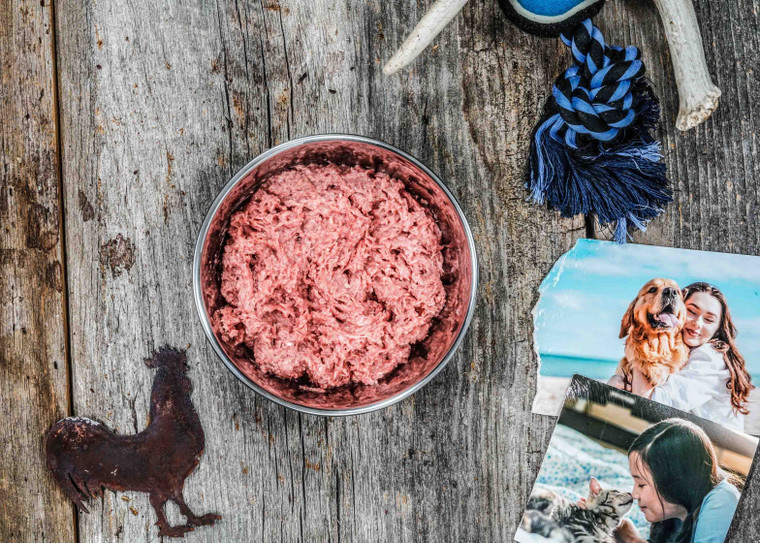
A bone-in raw chicken blend built to mirror what a predator actually eats. Pasture-raised, soy-free, corn-free Wisconsin chickens — ground carcasses, necks, wings, and muscle meat for natural calcium and connective tissue, plus an intentional organ ratio (gizzard, liver, heart) that tracks prey-model proportions. Leg bones excluded by design: all the mineral density, none of the splinter risk. Perfectly Rawsome Approved. Hand delivered to your door by local drivers.
- Built for raw-fed dogs and cats — works as a daily staple or rotation protein alongside bison, elk, or other proteins
- Pasture-raised, soy-free, and corn-free Wisconsin chickens; organ ratios calibrated to prey-model standards; leg bones excluded for safe bone-in raw feeding
- Fits raw, prey-model, carnivore, and species-appropriate raw feeding protocols
Not a byproduct mix. Not a commodity pet-food base. This is a bone-in ground chicken blend built from the ground up for raw-fed dogs and cats — starting with pasture-raised, soy-free, corn-free chickens raised in Wisconsin and ending with an organ ratio designed to mirror what a predator actually eats in the wild.
Every pound breaks down exactly: 90% meaty carcass, necks, wings, and muscle meat for natural calcium and connective tissue density; 7% gizzard, 2% liver, 1% heart to hit the organ proportions a prey-model raw diet calls for. Leg bones are excluded by design — the one structural change that makes bone-in raw feeding safe without stripping out the calcium that makes it worth doing in the first place. Ground fine enough for easy digestion, dense enough to deliver real nutritional value in every serving.
The chickens behind this blend are pasture-raised in Wisconsin — soy-free and corn-free from start to finish, with no added hormones, no antibiotics, and no fillers. Raised regeneratively on Wisconsin farms committed to soil health and responsible land stewardship. The result is a chicken that feeds differently than commodity grain-fed poultry, and it shows in how pets respond to it.
This blend is well-suited to prey-model raw, carnivore, and biologically appropriate raw food (BARF) feeding philosophies, making it a natural fit whether your pet is transitioning to raw for the first time or already thriving on a species-appropriate diet. Each 1 lb package is packaged frozen and can be stored in the freezer for up to 24 months; simply thaw in the refrigerator for 12–24 hours before serving, and use within 5–7 days of thawing. Customers who've switched to this blend report their pets take to it immediately — often with noticeably more enthusiasm than their usual protein. Several have made it a long-term dietary staple alongside other Northstar proteins.
- "They LOVED the chicken. It was fun to see how they reacted when they realized it wasn't their 'usual' bison." — Marcy G., Verified Buyer
- "Our cavaliers love the fresh favorite of your chicken pet recipe! They are 3 years old now and have been eating it all their lives!" — Barbara K., Verified Buyer
- "I'm thrilled to have found a chicken that both dogs are handling. We are now subscribers!" — Christy M., Verified Buyer
Serve raw — do not cook. Thaw 12–24 hours in the refrigerator before serving. Refrigerate after thawing and use within 5–7 days. Freezer storage up to 24 months. Perfectly Rawsome Approved and verified against raw-feeding safety standards. Consult your veterinarian before introducing a raw diet. Hand delivered to your door by local drivers.
Ingredients: 90% Meaty Carcass, Necks, Wings, and Muscle Meat, 7% Gizzard, 2% Liver, and 1% Heart. **Leg bones are not added to this blend to avoid risk of splinters.
Meet Bella — the ranch dog who inspired our pet food blends. →
Common Questions
How does pasture-raised, soy-free corn-free chicken differ nutritionally from the commodity chicken used in most commercial pet food?
Commodity broiler chickens raised in confinement on soy and corn diets produce meat with omega-6 to omega-3 ratios that can run as high as 20:1 or worse, because grain-heavy diets shift fatty acid profiles toward linoleic acid accumulation. Pasture-raised chickens foraging on grass and insects consistently show omega-6 to omega-3 ratios closer to 3:1 to 5:1, which is far more aligned with what wild prey would deliver. Beyond fats, chickens allowed outdoor access and natural movement develop denser connective tissue and higher myoglobin concentrations than sedentary confinement birds — both of which matter for dogs and cats processing whole muscle meat. Soy and corn elimination also removes two of the most common dietary allergen triggers in pet food, which is why many pets with chronic skin or digestive issues respond positively when switching to a grain-free, legume-free raw protein like this one.
Why are leg bones excluded from this blend, and does removing them reduce the calcium content?
Leg bones — specifically femurs and tibias — are load-bearing structural bones with a dense cortical composition that makes them far more prone to splintering into sharp fragments when ground, even in a fine-grind application. The carcass sections used here (backs, necks, wings) are cancellous or spongy in structure, which means they grind safely without producing the rigid shards that create laceration or obstruction risk. Calcium content is preserved because cancellous bone is actually highly bioavailable — the calcium-to-phosphorus ratio in raw ground bone from carcass and neck sections typically runs around 1.2:1 to 1.5:1, which closely matches the NRC recommended ratio for dogs and cats. So the exclusion of leg bones is a safety decision, not a nutritional compromise — the meaty carcass, necks, and wings in this blend deliver natural calcium without the structural hazard that makes whole raw bone feeding a legitimate concern.
What does the 7% gizzard, 2% liver, 1% heart organ breakdown actually do for a dog or cat physiologically?
Each organ contributes distinct compounds that cannot be replicated in adequate concentration by muscle meat alone. Liver at 2% provides retinol (preformed vitamin A) — the form dogs and cats can directly absorb, unlike beta-carotene — along with the highest natural concentration of vitamin B12, copper, and folate in any animal tissue. At 2%, the liver contribution is intentionally kept below the threshold (generally cited at around 5% of total diet) where excess retinol becomes a concern with daily feeding. Gizzard at 7% is technically a secreting organ under prey-model raw diet classification, delivering taurine, zinc, and a dense protein profile with a very low fat content that balances the richer muscle meat portions. Heart at 1% is the primary dietary source of CoQ10 (coenzyme Q10), a compound critical to mitochondrial energy production in cardiac and skeletal muscle, and also supplies taurine — particularly relevant for cats, who cannot synthesize taurine endogenously and must obtain it through diet. The combined organ ratio mirrors what a small predator would consume eating a whole prey animal of equivalent size.
What does Perfectly Rawsome Approved actually verify, and how is it different from USDA or AAFCO labeling?
Perfectly Rawsome is an independent raw-feeding advocacy and review organization that evaluates raw pet food products specifically against prey-model and biologically appropriate raw food (BARF) diet standards — a framework that USDA and AAFCO do not assess at all. USDA inspection covers human-food safety handling and processing conditions. AAFCO nutritional profiles are designed around cooked, extruded kibble formulations and use minimum/maximum thresholds that were not developed with raw, bone-in diets in mind. Perfectly Rawsome Approved means the product has been reviewed for ingredient sourcing integrity, organ-to-muscle-to-bone ratios, and absence of fillers, synthetic binders, and rendered byproduct fractions — things that matter specifically to raw feeders but that standard regulatory labels do not address. It functions as a peer verification signal within the raw-feeding community rather than a government compliance mark, which is why raw feeders treat it as a meaningful third-party confirmation rather than a marketing claim.
How do I calculate how much to feed my dog or cat per day, and does body weight tell the whole story?
The standard prey-model raw feeding guideline is 2% to 3% of the animal's ideal adult body weight per day in total raw food — so a 50-pound dog would receive roughly 1 to 1.5 pounds of food daily across one or two meals. Active working dogs, dogs in cold climates, and puppies (who are typically fed 2% to 3% of their projected adult weight) generally land at the higher end of that range, while sedentary or senior dogs often do well at or slightly below 2%. Cats are typically fed at 2% to 2.5% of ideal body weight, split into at least two daily meals because feline metabolic physiology is not well-adapted to single large-meal feeding. Body weight is a starting point, not a fixed answer — body condition score (visible rib feel without excess fat cover, defined waist) is a more reliable ongoing calibration tool than the scale alone. If your pet is losing or gaining weight unintentionally after 3 to 4 weeks at a given feeding rate, adjust by 0.25% of body weight increments rather than making large changes at once.
Can this blend be rotated with other proteins, and does prey-model raw feeding require nutritional variety across multiple species?
Yes — prey-model raw feeding is explicitly designed around rotation rather than reliance on a single protein source, because no single species provides a complete micronutrient profile across all vitamins and minerals in ideal proportions over time. Chicken is notably lower in manganese than ruminant proteins like bison or beef, while being comparatively higher in linoleic acid; ruminants contribute different organ vitamin concentrations and a more favorable omega fatty acid profile. Most experienced raw feeders rotate at minimum two to four protein species across a monthly feeding plan, which averages out micronutrient variation the same way a wild predator's varied prey availability does. This chicken blend works well as a primary protein given its complete bone-in structure and intentional organ ratios, but pairing it in rotation with a ruminant-based raw blend — bison, beef, or lamb — gives a more complete long-term nutritional picture without requiring synthetic supplementation.
What is actually in mass-market commercial pet food that isn't disclosed clearly on the label, and why does it matter for raw-fed pets?
AAFCO ingredient definitions allow terms like 'poultry byproduct meal' to encompass rendered material from beaks, feet, feathers, and undeveloped eggs — all combined, dried, and ground — without itemizing each component separately on the label. 'Natural flavors' can include rendered animal digests (acid or enzymatic hydrolysis of unspecified animal tissue) used as palatability enhancers. Preservatives like ethoxyquin — historically used to stabilize fish meal — do not always appear on finished pet food labels if they were applied at the ingredient level before the manufacturer received the raw material. Carrageenan and various gums used as binders in wet foods have been associated with intestinal inflammation in laboratory models, yet appear on labels under ingredient names most consumers do not recognize as gums. For raw feeders, this matters because the entire argument for species-appropriate raw feeding rests on ingredient transparency — knowing the exact tissue, the exact organ percentage, and the exact sourcing conditions, which is information that commodity pet food labels are structurally not required to provide.
- __Storage_Location:
- Frozen
- __Volume:
- 600
- __badge:
- Soy-Free Raw
- __Owner:
- NorthStar