

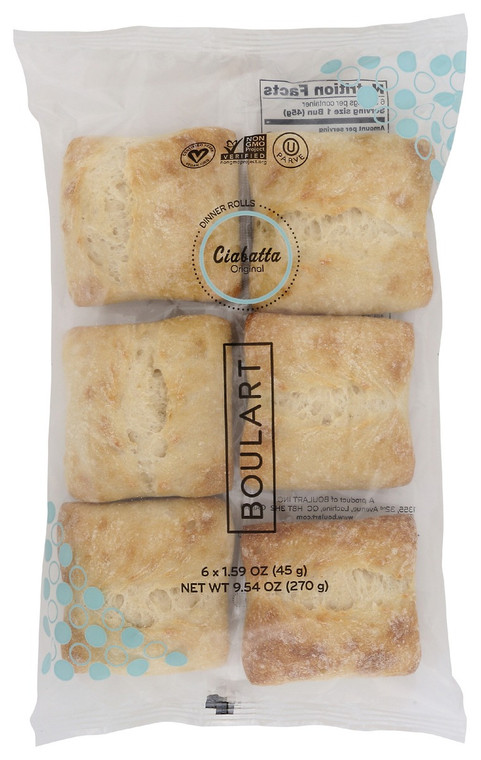
Ciabatta Dinner Rolls - 9.54 oz
Boulart
$3.29
Below are the available bulk discount rates for each individual item when you purchase a certain amount
- Buy 2 - 4 and get 2% off
- Buy 5 - 9 and get 4% off
- Buy 10 or above and get 8% off
(No reviews yet)

Write a Review
Boulart
Ciabatta Dinner Rolls - 9.54 oz
Boulart believes something as fundamental as bread should never be exclusive. These Ciabatta Dinner Rolls bring the airy, open crumb and crackling crust of true ciabatta to the everyday dinner table — baked with a short, honest ingredient list and a commitment to making good bread reachable for every household, not just the specialty bakery crowd.
- Individually portioned rolls with a crisp crust and tender, open crumb — ready for weeknight dinners, holiday tables, or a quick sandwich roll.
- Made with just five ingredients, including malted barley flour for natural fermentation depth and crust color, with no artificial preservatives or flavor enhancers.
- Non-GMO Project Verified, Vegan Action Certified, and Kosher (U-Parve) — bread that fits a plant-based table, a kosher kitchen, and everything in between.
Boulart's Ciabatta Dinner Rolls are built on a simple idea: a family shouldn't need a special occasion — or a specialty bakery budget — to bring well-made artisan bread to the table. Each roll carries the hallmark of true ciabatta: a light, irregular crumb and a crisp crust, baked in small batches rather than mass-produced for speed.
This multi-roll package is sized for a family dinner or a small gathering — enough for everyone at the table without excess. The dough is built from five ingredients: unbleached untreated enriched wheat flour, water, sea salt, yeast, and malted barley flour. Malted barley flour is a traditional baker's addition, prized for feeding the yeast during fermentation and developing the roll's golden crust color — a classic technique, not a shortcut.
Serve them warm alongside a weeknight soup or stew, split for individual sliders at a gathering, or simply with olive oil at the dinner table — the open crumb structure is especially good at soaking up sauce without falling apart.
Vegan Action Certified and Kosher (U-Parve), these rolls fit a plant-based table and a kosher kitchen without substitution; as a traditional wheat-based bread, however, they are not suited to keto, paleo, or carnivore diets. Non-GMO Project Verified means the ingredients have been independently checked against genetically modified inputs. Store at room temperature in the original packaging for best texture, or freeze for longer storage.
Ingredients: Unbleached Untreated Enriched Wheat Flour (Wheat Flour, Niacin, Reduced Iron, Thiamine Mononitrate, Riboflavin, Folic Acid), Water, Sea Salt, Yeast, and Malted Barley Flour.
Common Questions
How does this compare to a typical grocery store dinner roll?
Most mass-produced dinner rolls carry 10 to 15 ingredients, including dough conditioners like DATEM or sodium stearoyl lactylate, preservatives such as calcium propionate, and added sugars or soybean oil to speed up fermentation and extend shelf life. Boulart's ciabatta rolls use five ingredients: flour, water, sea salt, yeast, and malted barley flour, with no dough conditioners or preservatives. The tradeoff is shelf life — these rolls are meant to be eaten within a few days or frozen, not stored for weeks at room temperature. The result is a denser nutritional label but also a shorter, more recognizable ingredient list.
What does malted barley flour actually do in this bread?
Malted barley flour contains active amylase enzymes that break down starch in the dough into simple sugars, giving the yeast more food to ferment on. This produces two measurable effects: better oven spring (the rise that happens in the first few minutes of baking) and a deeper golden-brown crust from the Maillard reaction, since more residual sugar is available to caramelize. It's a technique bakers have used for over a century, distinct from adding table sugar, because it works with the dough's existing fermentation process rather than overriding it. You'll notice the effect most in the color and slight sweetness of the crust rather than in the crumb itself.
Are these rolls suitable for keto, paleo, or low-carb diets?
No. Each 1.59 oz roll is made from enriched wheat flour, so it runs roughly 25 to 28 grams of carbohydrate per roll, which puts it well outside standard keto limits of 20 to 50 grams of total carbs per day. It's also not paleo-compliant, since paleo protocols exclude grains entirely regardless of preparation method. These rolls are built for a plant-based or vegan table and a kosher kitchen — they fit vegan and kosher dietary frameworks specifically, not low-carb or grain-free ones.
What dishes work best with these rolls, and do I need to adjust anything?
The open, irregular crumb is suited to dishes where the bread needs to absorb liquid without turning to mush — French onion soup, a beef or lentil stew, or a simple bowl of olive oil and balsamic. Split horizontally, the rolls work well as slider buns for a small gathering; because the crumb is airy rather than dense, they hold up to sauce-heavy fillings better than a standard hamburger bun. If toasting for bruschetta or crostini, add 1 to 2 minutes to your usual toast time since the moist crumb takes slightly longer to crisp than a drier baguette slice. No recipe changes are needed for soup or stew service — just warm the rolls in a 300°F oven for 5 minutes before serving.
What do the Non-GMO and Vegan Action certifications actually verify?
Non-GMO Project Verified means an independent third party has audited the ingredient supply chain and tested for genetically modified inputs above a 0.9% threshold, the same standard used in the European Union. Vegan Action Certified requires the manufacturer to submit ingredient and processing documentation confirming no animal products or animal-derived processing aids, including things like L-cysteine (a dough conditioner sometimes derived from animal hair or feathers) that aren't always obvious from a label. The Kosher U-Parve designation comes from a rabbinical certifying agency and confirms the product contains neither meat nor dairy and was produced on equipment meeting kosher separation standards. All three marks require renewal audits, so they're not one-time claims — they're checked on an ongoing basis.
Why are the rolls baked in small batches instead of a continuous production line?
Ciabatta dough is very wet, typically 70 to 80% hydration compared to 60 to 65% for a standard dinner roll, which makes it too slack to run through high-speed mechanical shaping equipment without collapsing the air pockets that give ciabatta its open crumb. Small-batch production allows the dough to be handled gently and shaped with minimal degassing, preserving the irregular holes in the crumb. The tradeoff is consistency of shape — you'll notice each roll looks slightly different — but that irregularity is a direct result of the technique, not a defect.
This multi-roll package is sized for a family dinner or a small gathering — enough for everyone at the table without excess. The dough is built from five ingredients: unbleached untreated enriched wheat flour, water, sea salt, yeast, and malted barley flour. Malted barley flour is a traditional baker's addition, prized for feeding the yeast during fermentation and developing the roll's golden crust color — a classic technique, not a shortcut.
Serve them warm alongside a weeknight soup or stew, split for individual sliders at a gathering, or simply with olive oil at the dinner table — the open crumb structure is especially good at soaking up sauce without falling apart.
Vegan Action Certified and Kosher (U-Parve), these rolls fit a plant-based table and a kosher kitchen without substitution; as a traditional wheat-based bread, however, they are not suited to keto, paleo, or carnivore diets. Non-GMO Project Verified means the ingredients have been independently checked against genetically modified inputs. Store at room temperature in the original packaging for best texture, or freeze for longer storage.
Ingredients: Unbleached Untreated Enriched Wheat Flour (Wheat Flour, Niacin, Reduced Iron, Thiamine Mononitrate, Riboflavin, Folic Acid), Water, Sea Salt, Yeast, and Malted Barley Flour.
Common Questions
How does this compare to a typical grocery store dinner roll?
Most mass-produced dinner rolls carry 10 to 15 ingredients, including dough conditioners like DATEM or sodium stearoyl lactylate, preservatives such as calcium propionate, and added sugars or soybean oil to speed up fermentation and extend shelf life. Boulart's ciabatta rolls use five ingredients: flour, water, sea salt, yeast, and malted barley flour, with no dough conditioners or preservatives. The tradeoff is shelf life — these rolls are meant to be eaten within a few days or frozen, not stored for weeks at room temperature. The result is a denser nutritional label but also a shorter, more recognizable ingredient list.
What does malted barley flour actually do in this bread?
Malted barley flour contains active amylase enzymes that break down starch in the dough into simple sugars, giving the yeast more food to ferment on. This produces two measurable effects: better oven spring (the rise that happens in the first few minutes of baking) and a deeper golden-brown crust from the Maillard reaction, since more residual sugar is available to caramelize. It's a technique bakers have used for over a century, distinct from adding table sugar, because it works with the dough's existing fermentation process rather than overriding it. You'll notice the effect most in the color and slight sweetness of the crust rather than in the crumb itself.
Are these rolls suitable for keto, paleo, or low-carb diets?
No. Each 1.59 oz roll is made from enriched wheat flour, so it runs roughly 25 to 28 grams of carbohydrate per roll, which puts it well outside standard keto limits of 20 to 50 grams of total carbs per day. It's also not paleo-compliant, since paleo protocols exclude grains entirely regardless of preparation method. These rolls are built for a plant-based or vegan table and a kosher kitchen — they fit vegan and kosher dietary frameworks specifically, not low-carb or grain-free ones.
What dishes work best with these rolls, and do I need to adjust anything?
The open, irregular crumb is suited to dishes where the bread needs to absorb liquid without turning to mush — French onion soup, a beef or lentil stew, or a simple bowl of olive oil and balsamic. Split horizontally, the rolls work well as slider buns for a small gathering; because the crumb is airy rather than dense, they hold up to sauce-heavy fillings better than a standard hamburger bun. If toasting for bruschetta or crostini, add 1 to 2 minutes to your usual toast time since the moist crumb takes slightly longer to crisp than a drier baguette slice. No recipe changes are needed for soup or stew service — just warm the rolls in a 300°F oven for 5 minutes before serving.
What do the Non-GMO and Vegan Action certifications actually verify?
Non-GMO Project Verified means an independent third party has audited the ingredient supply chain and tested for genetically modified inputs above a 0.9% threshold, the same standard used in the European Union. Vegan Action Certified requires the manufacturer to submit ingredient and processing documentation confirming no animal products or animal-derived processing aids, including things like L-cysteine (a dough conditioner sometimes derived from animal hair or feathers) that aren't always obvious from a label. The Kosher U-Parve designation comes from a rabbinical certifying agency and confirms the product contains neither meat nor dairy and was produced on equipment meeting kosher separation standards. All three marks require renewal audits, so they're not one-time claims — they're checked on an ongoing basis.
Why are the rolls baked in small batches instead of a continuous production line?
Ciabatta dough is very wet, typically 70 to 80% hydration compared to 60 to 65% for a standard dinner roll, which makes it too slack to run through high-speed mechanical shaping equipment without collapsing the air pockets that give ciabatta its open crumb. Small-batch production allows the dough to be handled gently and shaped with minimal degassing, preserving the irregular holes in the crumb. The tradeoff is consistency of shape — you'll notice each roll looks slightly different — but that irregularity is a direct result of the technique, not a defect.
- __Storage_Location:
- Frozen
- __Volume:
- 2640
- __Owner:
- TCFarm