
Boneless Pork Chop Center Cut - 5 oz
Northstar BisonBelow are the available bulk discount rates for each individual item when you purchase a certain amount
- Buy 6 - 11 and get 4% off
- Buy 12 - 23 and get 8% off
- Buy 24 or above and get 12% off
Write a Review
Northstar Bison
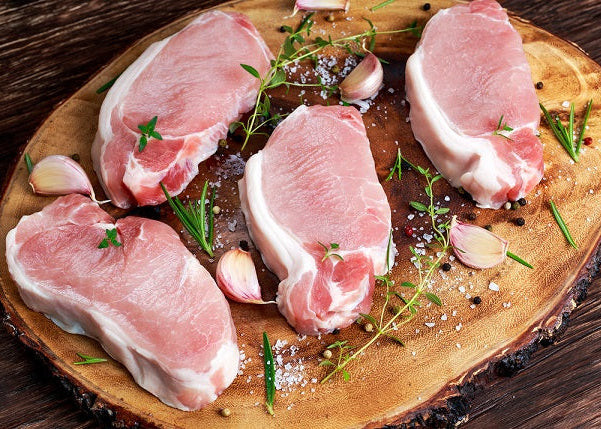
Boneless Pork Chop Center Cut - 5 oz
Corn-free. Soy-free. Raised on open pasture in Wisconsin and Minnesota — and it shows in every bite. Most grocery store pork chops come from confinement hogs pushed fast on corn and soy, producing pale, lean, virtually flavorless meat. Northstar's boneless center-cut chop comes from small family farms where hogs root and forage on pasture, fed zero corn and zero soy — no antibiotics, no growth hormones, no GMO feed, no pesticides or synthetic fertilizers on the land. Cut 1¼" thick through the center, one chop per pack, single ingredient — nothing added, nothing removed. The richer fat profile isn't a marketing claim; it's the direct result of how this animal lived. Don't trim it. Don't rush it. Let it work. Hand delivered to your door by local drivers.
- Cast iron with a hard sear finished in the oven, or low-and-slow on the grill — the fat bastes the meat as it cooks and delivers a savory depth commodity pork cannot replicate
- Pasture-raised on Wisconsin and Minnesota family farms with a 100% corn-free and 100% soy-free diet — a standard virtually absent from grocery store pork
- Fits keto, paleo, carnivore, gluten-free, corn-free, and soy-free protocols cleanly
Thick-cut, boneless, and raised the way pork was meant to be. Northstar's Center-Cut Pork Chop comes from small family farms in Wisconsin and Minnesota — hogs raised on open pasture, fed a 100% corn-free and 100% soy-free diet, with no antibiotics, no growth hormones, and no GMO feed. One chop per pack, cut 1¼" thick through the center — the cut that delivers the right balance of lean meat and flavorful fat in a single, clean portion.
Most pork chops at the grocery store come from hogs raised in confinement on a corn and soy diet — a combination that pushes fast growth at the expense of flavor and fat quality. Northstar's pasture-raised hogs root and forage on small family farms in Wisconsin and Minnesota that use no pesticides, herbicides, fungicides, or synthetic fertilizers. The difference lands on your plate: richer fat, deeper flavor, and a chop with real substance — not the pale, lean, flavorless cut the commodity pork industry normalized.
This is a raw, whole, single-ingredient cut — nothing added, nothing removed. Cook it the same way you'd approach any great center-cut chop, but account for the richer fat: don'trush it, don't trim it, and don't overcook it. Cast iron with a hard sear, finished in the oven, or low-and-slow on the grill — this chop rewards the method. The fat bastes the meat as it cooks and delivers the savory, old-fashioned pork flavor you won't find at the grocery store.
Customers who've tried it put it plainly. Northstar buyers consistently call out the tenderness, juiciness, and the corn-free and soy-free sourcing as the reasons they keep reordering — particularly those managing specific dietary and health protocols where feed quality matters as much as the cut itself.
- "Unbelievable tender & juicy." — Margaret D., Verified Buyer
- "One of my favorites from Northstar, and I love that it's corn and soy-free." — Karina K., Verified Buyer
- "Great as usual, will re-order!" — Scott B., Verified Buyer
Fits keto, paleo, carnivore, gluten-free, corn-free, and soy-free protocols. Packaged and delivered frozen. Keeps up to 24 months in the freezer or 3–5 days refrigerated after thawing. Thaw in the refrigerator for 24 hours before cooking. Hand delivered to your door by local drivers.
Ingredients: Corn and Soy Free Pastured Pork
Common Questions
How does pasture-raised, corn-free and soy-free pork actually differ from conventional grocery store pork in nutritional terms?
Conventional commodity pork comes from hogs finished on high-corn, high-soy diets in confinement. That diet accelerates growth but shifts the fat profile toward omega-6 fatty acids — corn is roughly 50–60% linoleic acid (an omega-6), and heavy corn feeding pushes that ratio into the tissue. Pasture-raised hogs eating diverse forage accumulate more omega-3 fatty acids and conjugated linoleic acid (CLA) in their fat. Published research on pasture-raised and forage-fed pork has consistently found meaningfully higher omega-3 levels and improved omega-6 to omega-3 ratios compared to confinement-raised pork fed corn and soy — with the magnitude of improvement varying based on forage access and grain content. CLA, which is associated with anti-inflammatory effects and improved body composition in animal and human studies, is also measurably higher in pasture-raised pork fat. The practical difference on the plate is fat that is more flavorful and less waxy, and a more favorable omega-6 to omega-3 ratio than you'll find in standard supermarket chops.
What does corn-free and soy-free actually mean for the hog's diet, and why does it matter beyond marketing?
Corn and soy are the two dominant feed ingredients in American commercial pork production because they are cheap and produce rapid weight gain. Corn is calorie-dense but nutritionally narrow — it is very high in omega-6 linoleic acid and low in vitamins, minerals, and diverse phytonutrients. Soy provides protein but also carries phytoestrogens and is almost universally derived from GMO seed stock in conventional operations. A 100% corn-free and 100% soy-free diet forces the feed program to use alternative protein and energy sources — often small grains, legumes, root vegetables, and forage — which produce a broader micronutrient and fatty acid profile in the animal's tissue. For people managing sensitivity to corn or soy derivatives, or following elimination protocols where those inputs matter, the feed matters because trace compounds from feed do transfer to fat tissue. Northstar's farms also use no pesticides, herbicides, fungicides, or synthetic fertilizers on the land the hogs forage, which means the forage itself is not carrying agrochemical residues up the food chain.
Does this pork chop fit a keto, carnivore, or paleo diet, and what are the approximate macros for a 6-ounce center-cut chop?
A boneless center-cut pork chop is one of the cleaner single-ingredient proteins available for keto, carnivore, and paleo protocols. A 6-ounce boneless center-cut pork chop (raw weight) contains approximately 34–40 grams of protein and 8–14 grams of fat depending on how much intramuscular and edge fat is present, with zero carbohydrates and no additives. That puts the calorie range at roughly 220–290 calories for the raw portion. Because Northstar's chops come from pasture-raised hogs on a richer forage diet, the fat is more flavorful and the fat profile is more varied than a conventional chop — which matters for carnivore practitioners who are specifically seeking fat quality, not just fat quantity. It is gluten-free, grain-free in the finished product, corn-free, soy-free, and contains no curing agents, binders, or nitrates — qualifying it across all four of the listed protocols without any modification needed.
Can I substitute this pork chop in recipes that typically call for conventional pork chops, and are there any cooking adjustments to account for?
Yes, this is a direct substitution in any recipe calling for a boneless center-cut pork chop — pan-seared pork chops, pork marsala, stuffed pork chops, sheet pan pork and vegetables, grilled chops, or braised pork in apple cider. The 1.25-inch thickness means it behaves similarly to a standard butcher-cut chop, but there are two practical differences to account for. First, the fat in pasture-raised pork renders more completely and at a slightly lower temperature than commodity pork fat, which tends to be harder and more saturated from the corn diet — so medium rather than high heat produces better results and avoids scorching the exterior before the interior is cooked. Second, the USDA-recommended safe internal temperature for whole pork is 145°F with a 3-minute rest, and pasture-raised pork is particularly penalized by overcooking — it will dry out above 155–160°F more noticeably than commodity pork because it has less water retention from added phosphates or brines. A probe thermometer is the most reliable tool. For recipes calling for thin-cut chops, simply butterfly the chop or ask for thinner cuts when available.
How do I verify that Northstar's farming and feed claims are accurate, and what do the certifications actually require?
Northstar Bison sources exclusively from small family farms in Wisconsin and Minnesota that they work with directly — not through commodity brokers or co-ops where traceability breaks down. The 100% corn-free and 100% soy-free claims are feed-level commitments verified through their farm relationships, not USDA-certified labels (there is no USDA-administered certification specifically for corn-free or soy-free feed). The non-GMO feed claim means the grains and feed crops used do not come from genetically modified seed varieties. No antibiotics ever means no sub-therapeutic or growth-promoting antibiotics at any point in the animal's life — not the weaker USDA claim of no antibiotics in the finishing period. No growth hormones is consistent with federal regulations that prohibit hormone implants for hogs, but its inclusion signals a standard of transparency. The no pesticides, herbicides, fungicides, or synthetic fertilizers claim applies to the farmland itself, verified through Northstar's farm partnerships. Customers seeking third-party certification should note that USDA Organic certification would independently verify pesticide-free land and non-GMO feed requirements, though Northstar's program goes beyond USDA Organic on the corn-free and soy-free specifications.
Why does most grocery store pork taste bland compared to what people describe as old-fashioned pork flavor, and what changed?
The shift is largely a product of selective breeding and feed changes that accelerated in the 1970s and 1980s. The pork industry responded to consumer demand for lean meat by breeding toward genetics that produce very low-fat loins — the so-called other white meat campaign of the 1980s and 1990s explicitly marketed pork as a lean protein comparable to chicken. The result was hogs that carry significantly less intramuscular fat (marbling) and subcutaneous fat than heritage or mixed-breed hogs raised outdoors. Marbling is where flavor compounds concentrate — oleic acid, lipid-soluble vitamins, and the precursors to Maillard reaction browning compounds all live in fat. Simultaneously, corn and soy finishing produces a blander, more uniform fat with fewer of the aromatic volatile compounds that come from varied forage. Pasture-raised hogs eating diverse grasses, roots, and non-GMO small grains accumulate a more complex fat — higher in oleic acid, richer in fat-soluble flavor precursors — which is why customers consistently describe the flavor difference as tasting like pork used to taste before commodity production standardized it away.
Is there a difference between pasture-raised and free-range or outdoor-access pork, and does the label matter when buying?
Yes, the distinctions are meaningful and USDA labeling rules do not require producers to define the terms consistently. Free-range on a pork label has no formal USDA standard — it can legally mean the hogs had a door to a small concrete outdoor area for some portion of their lives. Outdoor-access similarly has no acreage or duration requirement under standard USDA labeling. Pasture-raised is a stronger claim in practice but also lacks a mandatory federal standard unless it is backed by a third-party certification like Animal Welfare Approved or Certified Humane, both of which have animal welfare requirements for pigs — though neither mandates a specific minimum outdoor space per pig. Northstar's pasture-raised claim is grounded in direct farm sourcing from Wisconsin and Minnesota family farms where the hogs actively root and forage — the corn-free and soy-free diet is itself corroborating evidence, because confinement operations using those labels almost universally still feed corn and soy. When evaluating any pasture-raised pork claim, the most useful verification questions are: what are the hogs eating, where are the farms, and is there a direct relationship between the brand and the farm — not just a broker arrangement.
- __Storage_Location:
- Frozen
- __Volume:
- 1500
- __badge:
- Corn Soy-Free
- __Owner:
- NorthStar