


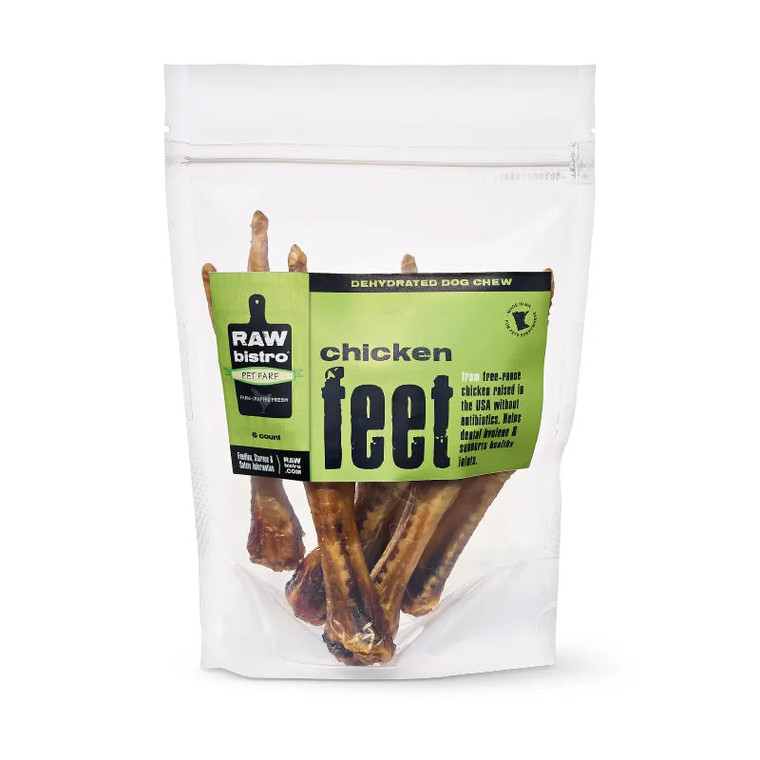
Dehydrated Chicken Feet for Dogs - 6 ct
Raw Bistro
$10.99
(No reviews yet)

Write a Review
Raw Bistro
Dehydrated Chicken Feet for Dogs - 6 ct
One ingredient, gently dried, and built for a job: real chicken feet, naturally rich in glucosamine, chondroitin, and collagen — the same compounds joint supplements try to replicate in a pill. Raw Bistro dries them in small batches at its Cannon Falls, Minnesota facility from free-range chickens raised without antibiotics, then removes every nail by hand before they're packed. No preservatives, no fillers, nothing else in the bag — which is exactly why this chew earned a spot on Susan Thixton's 2026/27 Treat List, a list built on ingredient transparency, not marketing claims.
- A crunchy, satisfying chew that works cartilage and gum tissue simultaneously — supports dental health while giving dogs of any size a longer-lasting chew than a biscuit; nails removed before drying for safer chewing.
- Single ingredient, small-batch dried: 100% chicken feet from free-range, antibiotic-free birds, dehydrated (not fried or flavored) in a Minnesota Grown facility — no preservatives added, ever.
- A grain-free, single-protein chew well suited to dogs on limited-ingredient diets, or any owner looking for a treat with nothing to decode on the label.
Dehydrated chicken feet are one of the few dog chews that give a dog real joint-supporting nutrition instead of empty crunch — cartilage, tendon, and skin naturally deliver glucosamine, chondroitin, and collagen, the building blocks of healthy hips and connective tissue.
Raw Bistro's version is dried, not fried or smoked, at its Cannon Falls, Minnesota facility using free-range chickens raised without antibiotics. Nails are removed by hand before drying for a safer chew, and nothing is added afterward — no preservatives, no flavor coatings, no fillers. Each pack holds 6 whole dried feet, sized for dogs of every size to work on as a supervised chew or occasional treat.
The dehydration process concentrates the natural collagen and cartilage instead of cooking it away, so the crunch itself is doing double duty: mechanical abrasion against the teeth for dental support, and a slow-release source of joint nutrients as your dog works through it. It's the kind of single-ingredient functionality that got this chew named to Susan Thixton's 2026/27 Treat List — a recognition built on verified ingredient transparency, not brand marketing.
Offer one as an occasional treat or supervised chew session — always watch your dog while chewing, and this is intended for intermittent or supplemental feeding only, not a meal replacement. As a single-ingredient animal product with nothing added, these feet are naturally suited to grain-free, limited-ingredient, paleo, keto, and raw/carnivore feeding styles. Store the pack in a cool, dry pantry or in the freezer for maximum freshness once opened. Not intended for human consumption or cooking.
Ingredients: Dehydrated Chicken Feet.
Common Questions
How does dehydrated chicken feet compare nutritionally to conventional rawhide or dyed chews?
Dehydrated chicken feet run roughly 65-70% protein and 12-15% fat by dry weight, with the remainder made up of natural collagen, cartilage, and trace minerals from bone and skin. Rawhide, by contrast, is a processed cattle-hide byproduct often treated with sodium sulfide to strip hair, then bleached with hydrogen peroxide and sometimes coated with artificial smoke flavor or dyes before drying. A chicken foot has one ingredient and no processing aids; a rawhide chew typically has none of its original nutritional value left after the tanning-style process, since the chemical treatment degrades much of the natural collagen structure. Dogs also digest dehydrated chicken feet more completely than rawhide, which can sit in the stomach for hours before breaking down and has been linked to blockage risk in veterinary case reports.
What specific compounds in chicken feet actually support joint health, and how do they work?
Chicken feet are almost entirely cartilage, tendon, and skin, tissues that are naturally dense in type II collagen, glucosamine, and chondroitin sulfate. Glucosamine is a building block cartilage cells use to synthesize new cartilage matrix, while chondroitin sulfate helps cartilage retain water for shock absorption and inhibits enzymes that break cartilage down. Type II collagen, when consumed, has been studied for a mechanism called oral tolerance, where small collagen fragments help modulate joint inflammation rather than acting as a structural supplement directly. Because the feet are dehydrated at low temperatures rather than cooked at high heat, these compounds stay largely intact instead of denaturing, which is the main nutritional argument for feeding the whole foot rather than an extracted supplement pill.
Do dehydrated chicken feet fit a raw or prey-model diet for dogs?
Yes, chicken feet are a staple in prey-model raw (PMR) and BARF-style feeding because they supply the edible bone, cartilage, and connective tissue ratios those protocols call for without adding carbohydrate filler. A single dehydrated foot is roughly 60-70% protein, 10-15% fat, and low in ash/mineral content relative to weight-bearing bones, making it easy to fit into a raw feeder's daily protein-to-bone ratio without overloading calcium intake the way a whole bone-in meal might. Because it's 100% chicken with nothing added, it also works for dogs on limited-ingredient or novel-protein elimination diets, since there's no filler, grain, or secondary protein source to trigger a reaction. It should be counted as a treat or supplement to a complete meal, not a replacement for balanced raw or kibble feeding, since it isn't formulated to deliver complete daily nutrition on its own.
Can chicken feet be used in homemade dog food recipes, and does drying change how they're used?
Chicken feet are commonly simmered into bone broth for dogs, since low, slow heat extracts collagen and glucosamine into a gelatin-rich liquid that can be poured over kibble or mixed into homemade meals. Because this product is dehydrated rather than raw, it's meant to be fed as a whole chew or treat, not rehydrated or cooked into broth, since the drying process is the opposite of what broth-making requires. If a recipe calls for raw chicken feet as a broth ingredient, you'd want raw feet specifically rather than this dehydrated product. As a direct substitute for other single-ingredient chews like bully sticks, pig ears, or beef trachea, it can be swapped in at a similar treat frequency without any recipe adjustment needed.
What do the Organic and 100% Grass-Fed claims actually verify on a poultry product like this?
For chicken specifically, these claims speak to the birds' feed and living conditions rather than a literal grass diet, since chickens are omnivores, not grazing ruminants; in practice it points to birds raised free-range on pasture, fed an organic feed ration, and never given antibiotics. The organic certification requires third-party audited feed sourcing and prohibits synthetic pesticides, antibiotics, and hormones anywhere in the supply chain, which is verifiable through the USDA Organic seal and its associated certifying body records. Beyond the label, this product was named to Susan Thixton's 2026/27 Treat List, an independent review that vets ingredient sourcing and manufacturing transparency rather than accepting brand claims at face value. Buyers who want to verify further can request the certifying agent's number from the company, which is standard practice for USDA Organic-labeled products.
Why are the nails removed from these chicken feet, and does that affect safety?
Nails are cut off by hand before the dehydration process, which removes the sharpest, most brittle part of the foot that could otherwise splinter or cause a puncture injury in the mouth or digestive tract. This is a manual step done at the Cannon Falls, Minnesota facility rather than an automated trim, which allows for more consistent removal across each batch. It doesn't eliminate the need for supervision, since the foot itself still has small bones that require full chewing before swallowing, but it does reduce one specific injury risk that's common with unprocessed feet. This detail is also a marker of a smaller-scale, hands-on production process rather than mass automated processing, which is part of why the product carries single-ingredient, minimally processed claims.
Raw Bistro's version is dried, not fried or smoked, at its Cannon Falls, Minnesota facility using free-range chickens raised without antibiotics. Nails are removed by hand before drying for a safer chew, and nothing is added afterward — no preservatives, no flavor coatings, no fillers. Each pack holds 6 whole dried feet, sized for dogs of every size to work on as a supervised chew or occasional treat.
The dehydration process concentrates the natural collagen and cartilage instead of cooking it away, so the crunch itself is doing double duty: mechanical abrasion against the teeth for dental support, and a slow-release source of joint nutrients as your dog works through it. It's the kind of single-ingredient functionality that got this chew named to Susan Thixton's 2026/27 Treat List — a recognition built on verified ingredient transparency, not brand marketing.
Offer one as an occasional treat or supervised chew session — always watch your dog while chewing, and this is intended for intermittent or supplemental feeding only, not a meal replacement. As a single-ingredient animal product with nothing added, these feet are naturally suited to grain-free, limited-ingredient, paleo, keto, and raw/carnivore feeding styles. Store the pack in a cool, dry pantry or in the freezer for maximum freshness once opened. Not intended for human consumption or cooking.
Ingredients: Dehydrated Chicken Feet.
Common Questions
How does dehydrated chicken feet compare nutritionally to conventional rawhide or dyed chews?
Dehydrated chicken feet run roughly 65-70% protein and 12-15% fat by dry weight, with the remainder made up of natural collagen, cartilage, and trace minerals from bone and skin. Rawhide, by contrast, is a processed cattle-hide byproduct often treated with sodium sulfide to strip hair, then bleached with hydrogen peroxide and sometimes coated with artificial smoke flavor or dyes before drying. A chicken foot has one ingredient and no processing aids; a rawhide chew typically has none of its original nutritional value left after the tanning-style process, since the chemical treatment degrades much of the natural collagen structure. Dogs also digest dehydrated chicken feet more completely than rawhide, which can sit in the stomach for hours before breaking down and has been linked to blockage risk in veterinary case reports.
What specific compounds in chicken feet actually support joint health, and how do they work?
Chicken feet are almost entirely cartilage, tendon, and skin, tissues that are naturally dense in type II collagen, glucosamine, and chondroitin sulfate. Glucosamine is a building block cartilage cells use to synthesize new cartilage matrix, while chondroitin sulfate helps cartilage retain water for shock absorption and inhibits enzymes that break cartilage down. Type II collagen, when consumed, has been studied for a mechanism called oral tolerance, where small collagen fragments help modulate joint inflammation rather than acting as a structural supplement directly. Because the feet are dehydrated at low temperatures rather than cooked at high heat, these compounds stay largely intact instead of denaturing, which is the main nutritional argument for feeding the whole foot rather than an extracted supplement pill.
Do dehydrated chicken feet fit a raw or prey-model diet for dogs?
Yes, chicken feet are a staple in prey-model raw (PMR) and BARF-style feeding because they supply the edible bone, cartilage, and connective tissue ratios those protocols call for without adding carbohydrate filler. A single dehydrated foot is roughly 60-70% protein, 10-15% fat, and low in ash/mineral content relative to weight-bearing bones, making it easy to fit into a raw feeder's daily protein-to-bone ratio without overloading calcium intake the way a whole bone-in meal might. Because it's 100% chicken with nothing added, it also works for dogs on limited-ingredient or novel-protein elimination diets, since there's no filler, grain, or secondary protein source to trigger a reaction. It should be counted as a treat or supplement to a complete meal, not a replacement for balanced raw or kibble feeding, since it isn't formulated to deliver complete daily nutrition on its own.
Can chicken feet be used in homemade dog food recipes, and does drying change how they're used?
Chicken feet are commonly simmered into bone broth for dogs, since low, slow heat extracts collagen and glucosamine into a gelatin-rich liquid that can be poured over kibble or mixed into homemade meals. Because this product is dehydrated rather than raw, it's meant to be fed as a whole chew or treat, not rehydrated or cooked into broth, since the drying process is the opposite of what broth-making requires. If a recipe calls for raw chicken feet as a broth ingredient, you'd want raw feet specifically rather than this dehydrated product. As a direct substitute for other single-ingredient chews like bully sticks, pig ears, or beef trachea, it can be swapped in at a similar treat frequency without any recipe adjustment needed.
What do the Organic and 100% Grass-Fed claims actually verify on a poultry product like this?
For chicken specifically, these claims speak to the birds' feed and living conditions rather than a literal grass diet, since chickens are omnivores, not grazing ruminants; in practice it points to birds raised free-range on pasture, fed an organic feed ration, and never given antibiotics. The organic certification requires third-party audited feed sourcing and prohibits synthetic pesticides, antibiotics, and hormones anywhere in the supply chain, which is verifiable through the USDA Organic seal and its associated certifying body records. Beyond the label, this product was named to Susan Thixton's 2026/27 Treat List, an independent review that vets ingredient sourcing and manufacturing transparency rather than accepting brand claims at face value. Buyers who want to verify further can request the certifying agent's number from the company, which is standard practice for USDA Organic-labeled products.
Why are the nails removed from these chicken feet, and does that affect safety?
Nails are cut off by hand before the dehydration process, which removes the sharpest, most brittle part of the foot that could otherwise splinter or cause a puncture injury in the mouth or digestive tract. This is a manual step done at the Cannon Falls, Minnesota facility rather than an automated trim, which allows for more consistent removal across each batch. It doesn't eliminate the need for supervision, since the foot itself still has small bones that require full chewing before swallowing, but it does reduce one specific injury risk that's common with unprocessed feet. This detail is also a marker of a smaller-scale, hands-on production process rather than mass automated processing, which is part of why the product carries single-ingredient, minimally processed claims.
- __Storage_Location:
- Dry
- __Volume:
- 500
- __Owner:
- Raw Bistro
- __badge:
- Single-Ingredient