

Frozen Raw Bison Entree for Dogs - 18 lb
Raw Bistro
$246.18
(No reviews yet)

Write a Review
Raw Bistro
Frozen Raw Bison Entree for Dogs - 18 lb
This is what raw feeding was built to look like: whole-prey nutrition, not a recipe stitched together from trimmings. Raw Bistro's Bison Entree grinds bison muscle meat with heart, kidney, liver, and bone — the organ-to-muscle ratio a wild canine would actually hunt down — sourced from free-range bison pasture-raised on Midwest family farms without antibiotics or added hormones. Organic butternut squash, broccoli, red peppers, blueberries, and walnut oil fill in the fiber, antioxidants, and omega fats a muscle-only grind skips entirely, and every batch is mixed in small custom runs at Raw Bistro's own hyper-clean facility in Cannon Falls, Minnesota.
- Formulated to meet AAFCO nutrient profiles for all life stages — feed as a complete diet from puppyhood through the senior years, or use to transition a kibble-fed dog onto raw.
- Nose-to-tail composition — heart, kidney, liver, and ground bone included, not just trimmed muscle — delivers organ-sourced nutrients like taurine and iron that boneless ground meat leaves out entirely.
- Grain-free with no fillers or flavor enhancers, making it a fit for dogs on limited-ingredient or sensitive-stomach raw diets.
Raw Bistro's Bison Entree is a raw bison dog food built around one idea: a dog's diet should look like what a dog would eat if it caught its own dinner. That means muscle meat plus organs — bison heart, kidney, and liver alongside ground bison bone — not a formula reverse-engineered from rendered meal.
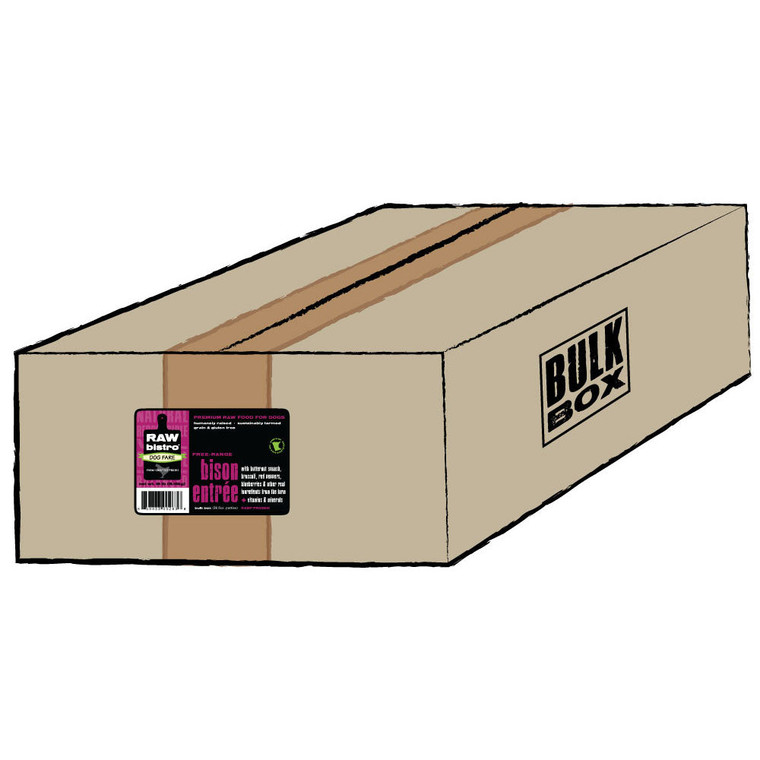
Each 18 lb bulk box comes packaged as individually portioned 8 oz. patties, so feeding is a matter of counting patties, not hacking apart a frozen block. The bison itself is free-range and pasture-raised on Midwest family farms, raised without antibiotics or added hormones. Organic butternut squash, broccoli, red peppers, and blueberries are folded in for fiber, minerals, enzymes, and antioxidants, with organic walnut oil and kelp rounding out the fat and micronutrient profile. Everything is mixed in small custom batches at Raw Bistro's own facility in Cannon Falls, Minnesota — not a co-packer running multiple brands through the same line.
Nutritionally, this entree runs 14% crude protein (min) and 7% crude fat (min) on an as-fed basis at 74% moisture — a moisture level that reflects real, unprocessed meat rather than a dehydrated kibble formula — and calculates to 1,338 kcal/kg, or about 76 kcal per 2 oz. serving — a standard reference measure used for calorie calculation, separate from the 8 oz. patty size the product actually ships in. It's formulated to meet AAFCO nutrient profiles for all life stages, so it works as a complete diet for puppies through seniors. With no grains, fillers, or rendered meal, it's grain-free and biologically appropriate — well suited to dogs on a prey-model raw or species-appropriate feeding plan, whether fed as a complete diet or rotated alongside other proteins.
Keep frozen until ready to feed — the entree stores frozen, and stays fresh in the freezer until you're ready to thaw portions. Thaw the number of patties your dog needs in the refrigerator, and use Raw Bistro's feeding calculator (by weight and % of total diet) to set a daily baseline if you're new to raw feeding or transitioning gradually from kibble.
Longtime feeders describe a pattern of visibly better condition and fewer vet visits beyond routine care. Newer feeders note coat and energy changes within the first few months.
Ingredients: Bison, Bison Heart, Bison Kidney, Ground Bison Bone, Bison Liver, Organic Butternut Squash, Organic Broccoli, Organic Red Peppers, Organic Blueberries, Organic Walnut Oil, Organic Kelp, Inulin (extract of chicory), Sea Salt, Zinc Amino Acid Chelate, Vitamin E Supplement, Manganese Amino Acid Chelate, and Vitamin D3 Supplement.
Common Questions
How is this different from feeding kibble?
This entree is 74% moisture (max) versus roughly 10% in most dry kibble, meaning the protein and fat come from unprocessed meat rather than a rendered, dehydrated meal. It contains no grain fillers and no synthetic preservatives, and it includes organ meat (heart, kidney, liver) and ground bone, which most kibble formulas replace with plant-based protein concentrates and synthetic vitamin premixes. Guaranteed analysis is 14% crude protein (min) and 7% crude fat (min) on an as-fed basis, which is not directly comparable to kibble's dry-matter percentages without adjusting for moisture.
Why include organ meats like heart, kidney, and liver?
Organ meat is where a whole-prey diet concentrates its micronutrients: liver is dense in vitamin A and copper, heart is a natural source of taurine (important for canine cardiac health), and kidney contributes selenium and B vitamins. A muscle-meat-only grind — which is how many commercial raw diets are formulated — misses these nutrients unless they're added back synthetically. This recipe supplies them from the organs themselves.
Is this suitable for puppies, or only adult dogs?
This entree is formulated to meet AAFCO nutrient profiles for all life stages, which includes growth (puppy) requirements, not just adult maintenance. That's a higher bar than an 'adult maintenance only' formulation, since growth profiles require higher minimums for protein, fat, and specific minerals like calcium and phosphorus.
How much should I feed my dog daily?
Raw Bistro's online feeding calculator uses your dog's weight and the percentage of their total diet coming from this entree to generate a daily baseline recommendation. As a reference point, each 2 oz. patty provides about 76 kcal, and the entree calculates to 1,338 kcal/kg overall. Actual amounts vary with a dog's activity level, age, and whether it's being fed as 100% of the diet or as a partial raw addition.
What do the organic vegetables and blueberries add nutritionally?
Organic butternut squash, broccoli, and red peppers contribute dietary fiber, minerals, and enzymes that a straight meat-and-organ grind doesn't provide on its own. Organic blueberries add antioxidant polyphenols, and organic walnut oil and kelp round out essential fatty acids and trace minerals like iodine. Together they're formulated to complement the animal-based nutrients rather than dilute them with cheap bulk fillers.
How was the bison raised, and how do I know it's not just a marketing claim?
The bison is described as free-range and pasture-raised on Midwest family farms, raised without antibiotics or added hormones. Production happens in small custom batches at Raw Bistro's own facility in Cannon Falls, Minnesota, rather than through a third-party co-packer — a structure that gives the brand direct oversight of both sourcing and processing rather than outsourcing quality control to a supplier.
Can this be mixed with my dog's current kibble, or does it have to be fed exclusively?
It can be fed either way. Raw Bistro's feeding calculator lets you specify what percentage of your dog's total diet this entree should make up — from a small topper addition (10%) up to a full 100% raw diet — so you can transition gradually or use it as a partial supplement alongside an existing kibble routine.
Each 18 lb bulk box comes packaged as individually portioned 8 oz. patties, so feeding is a matter of counting patties, not hacking apart a frozen block. The bison itself is free-range and pasture-raised on Midwest family farms, raised without antibiotics or added hormones. Organic butternut squash, broccoli, red peppers, and blueberries are folded in for fiber, minerals, enzymes, and antioxidants, with organic walnut oil and kelp rounding out the fat and micronutrient profile. Everything is mixed in small custom batches at Raw Bistro's own facility in Cannon Falls, Minnesota — not a co-packer running multiple brands through the same line.
Nutritionally, this entree runs 14% crude protein (min) and 7% crude fat (min) on an as-fed basis at 74% moisture — a moisture level that reflects real, unprocessed meat rather than a dehydrated kibble formula — and calculates to 1,338 kcal/kg, or about 76 kcal per 2 oz. serving — a standard reference measure used for calorie calculation, separate from the 8 oz. patty size the product actually ships in. It's formulated to meet AAFCO nutrient profiles for all life stages, so it works as a complete diet for puppies through seniors. With no grains, fillers, or rendered meal, it's grain-free and biologically appropriate — well suited to dogs on a prey-model raw or species-appropriate feeding plan, whether fed as a complete diet or rotated alongside other proteins.
Keep frozen until ready to feed — the entree stores frozen, and stays fresh in the freezer until you're ready to thaw portions. Thaw the number of patties your dog needs in the refrigerator, and use Raw Bistro's feeding calculator (by weight and % of total diet) to set a daily baseline if you're new to raw feeding or transitioning gradually from kibble.
Longtime feeders describe a pattern of visibly better condition and fewer vet visits beyond routine care. Newer feeders note coat and energy changes within the first few months.
- "I've been feeding my dogs and cats Raw Bistro for about six years now and my pets thrive. The only time any of my pets see the vet is for check ups and dentals as they never get sick." — Vivian B., Verified Buyer
- "This is definitely my Rottweiler Apollo's favorite of all the protein available. He has been fed 100% raw diet from Raw Bistro since 8 weeks of age and he looks lean, healthy, strong and has an incredibly shiny coat! He is 20 months old, weighs 112 lbs of lean muscle." — Ohridia P., Verified Buyer
- "Quality ingredients and amazing customer service." — Nisreen P., Verified Buyer
Ingredients: Bison, Bison Heart, Bison Kidney, Ground Bison Bone, Bison Liver, Organic Butternut Squash, Organic Broccoli, Organic Red Peppers, Organic Blueberries, Organic Walnut Oil, Organic Kelp, Inulin (extract of chicory), Sea Salt, Zinc Amino Acid Chelate, Vitamin E Supplement, Manganese Amino Acid Chelate, and Vitamin D3 Supplement.
Common Questions
How is this different from feeding kibble?
This entree is 74% moisture (max) versus roughly 10% in most dry kibble, meaning the protein and fat come from unprocessed meat rather than a rendered, dehydrated meal. It contains no grain fillers and no synthetic preservatives, and it includes organ meat (heart, kidney, liver) and ground bone, which most kibble formulas replace with plant-based protein concentrates and synthetic vitamin premixes. Guaranteed analysis is 14% crude protein (min) and 7% crude fat (min) on an as-fed basis, which is not directly comparable to kibble's dry-matter percentages without adjusting for moisture.
Why include organ meats like heart, kidney, and liver?
Organ meat is where a whole-prey diet concentrates its micronutrients: liver is dense in vitamin A and copper, heart is a natural source of taurine (important for canine cardiac health), and kidney contributes selenium and B vitamins. A muscle-meat-only grind — which is how many commercial raw diets are formulated — misses these nutrients unless they're added back synthetically. This recipe supplies them from the organs themselves.
Is this suitable for puppies, or only adult dogs?
This entree is formulated to meet AAFCO nutrient profiles for all life stages, which includes growth (puppy) requirements, not just adult maintenance. That's a higher bar than an 'adult maintenance only' formulation, since growth profiles require higher minimums for protein, fat, and specific minerals like calcium and phosphorus.
How much should I feed my dog daily?
Raw Bistro's online feeding calculator uses your dog's weight and the percentage of their total diet coming from this entree to generate a daily baseline recommendation. As a reference point, each 2 oz. patty provides about 76 kcal, and the entree calculates to 1,338 kcal/kg overall. Actual amounts vary with a dog's activity level, age, and whether it's being fed as 100% of the diet or as a partial raw addition.
What do the organic vegetables and blueberries add nutritionally?
Organic butternut squash, broccoli, and red peppers contribute dietary fiber, minerals, and enzymes that a straight meat-and-organ grind doesn't provide on its own. Organic blueberries add antioxidant polyphenols, and organic walnut oil and kelp round out essential fatty acids and trace minerals like iodine. Together they're formulated to complement the animal-based nutrients rather than dilute them with cheap bulk fillers.
How was the bison raised, and how do I know it's not just a marketing claim?
The bison is described as free-range and pasture-raised on Midwest family farms, raised without antibiotics or added hormones. Production happens in small custom batches at Raw Bistro's own facility in Cannon Falls, Minnesota, rather than through a third-party co-packer — a structure that gives the brand direct oversight of both sourcing and processing rather than outsourcing quality control to a supplier.
Can this be mixed with my dog's current kibble, or does it have to be fed exclusively?
It can be fed either way. Raw Bistro's feeding calculator lets you specify what percentage of your dog's total diet this entree should make up — from a small topper addition (10%) up to a full 100% raw diet — so you can transition gradually or use it as a partial supplement alongside an existing kibble routine.
- __Storage_Location:
- Frozen
- __Volume:
- 500
- __Owner:
- Raw Bistro
- __badge:
- Pasture-Raised