

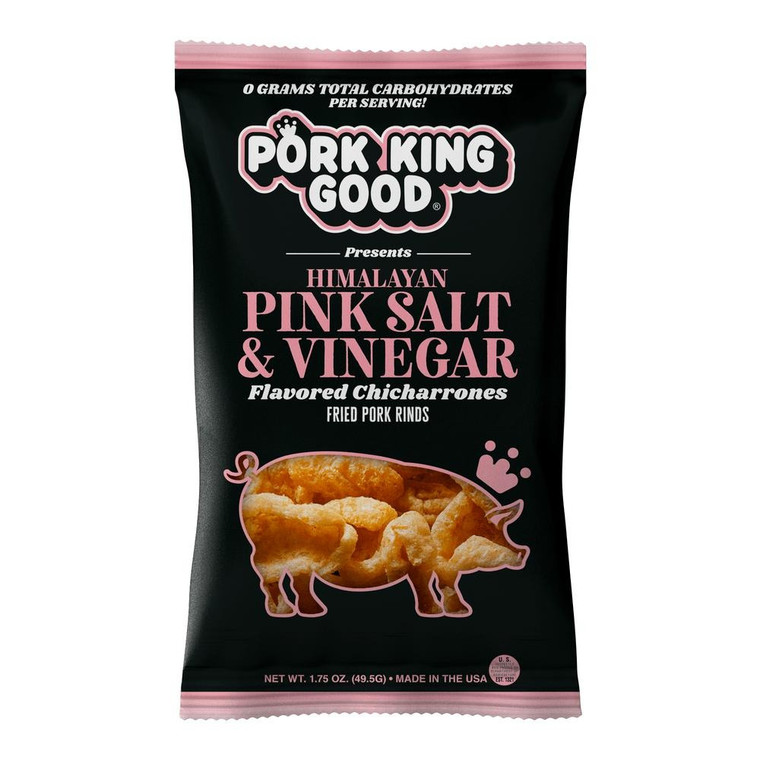
Himalayan Pink Salt & Vinegar Pork Rinds - 1.75 oz
Pork King Good
$3.99
Below are the available bulk discount rates for each individual item when you purchase a certain amount
- Buy 4 - 7 and get 12% off
- Buy 8 - 23 and get 22% off
- Buy 24 or above and get 32% off
(No reviews yet)

Write a Review
Pork King Good
Himalayan Pink Salt & Vinegar Pork Rinds - 1.75 oz
Pork King Good didn't season a stock pork rind and slap a salt & vinegar sticker on it — they chased down that exact mouth-puckering tang of a salt & vinegar chip and built it from real Himalayan pink salt, then fried it up in the same Milwaukee-area kettles a 74-year-old pork rind manufacturer has run for generations. In 2022 Pork King Good bought that manufacturer outright, becoming the only woman-owned pork rind maker in the country — so every batch of this snap-and-crunch flavor carries decades of Wisconsin rendering know-how under a brand that still names its other flavors things like "Stupid Hot."
- Pack it for a road trip, set it out with dips at game day, or toss a handful next to a sandwich when you want crunch without the carbs
- Fried in the company's own rendered pork fat and seasoned with real Himalayan pink salt and sea salt — sodium diacetate and citric acid do the food-safety work, nothing artificial anywhere in the mix
- Zero grams of total carbohydrates per serving, naturally gluten-free, and built for keto and paleo kitchens
Salt & vinegar chips get their zing from a spray of powder. Pork King Good went a different direction: Himalayan pink salt, sea salt, and citric acid deliver that salt-and-vinegar tang fried straight into the rind, so the flavor doesn't sit on top — it's cooked in.
This 1.75 oz bag comes out of the Milwaukee-area facility Pork King Good acquired in May 2022, a 74-year-old pork rind manufacturer they'd been one of the largest customers of for years before buying it outright — making Pork King Good the only woman-owned pork rind manufacturing business in the country. The rinds are cooked in the company's own rendered pork fat, the same process this Wisconsin operation has run since long before Pork King Good existed, just under new (and considerably funnier) ownership.
Each serving carries 0 grams of total carbohydrates, so these keto pork rinds slot into a keto or low-carb day without any math. Set a bowl out at a tailgate, pack a bag for a hike, or keep one in the pantry for whenever a craving for that salty-sour chip flavor hits — this one just happens to be built without the flour, the seed oils, or the carb count that usually comes with it.
Gluten-free and paleo-friendly by nature of what's (and isn't) in the bag, these rinds also fit comfortably into a carnivore-style eating pattern, with an ingredient list built around pork, fat, and salt, plus a touch of sodium diacetate and citric acid for food safety. Store at room temperature in a cool, dry pantry; reseal the bag between servings to keep the crunch where it belongs.
Ingredients: Pork Rinds (Cooked In Pork Fat), Himalayan Salt, Sea Salt, Sodium Diacetate, and Citric Acid.
Common Questions
How does the carb and protein profile compare to a regular bag of salt and vinegar potato chips?
A standard 1 oz serving of salt and vinegar potato chips runs about 15 grams of carbohydrate and 2 grams of protein, most of that carb load coming from the sliced potato itself. This bag flips that ratio: 0 grams of total carbohydrate per serving and roughly 9 grams of protein per ounce, since the base ingredient is fried pork skin rather than starch. The fat in a potato chip usually comes from a seed oil like sunflower or canola, while this product is cooked in rendered pork fat. Calorie counts land in a similar range between the two snacks, but the macro split is essentially inverted.
How do you get a vinegar tang cooked into the rind instead of dusted on as a powder?
The tang comes from citric acid and sodium diacetate, both added directly to the seasoning applied during frying rather than sprayed on afterward. Sodium diacetate is the sodium salt of acetic acid, the same compound that gives actual vinegar its sourness, and it releases that acetic acid character as it dissolves on a moist surface. Citric acid adds a brighter, sharper note and also acts as a mild preservative by lowering surface pH. Because both are worked into the rind during cooking rather than coated on top after, the sour flavor holds up over the shelf life of the bag instead of fading the way a topical vinegar powder can.
Does this fit into keto, paleo, or carnivore eating patterns?
For keto, where most protocols cap net carbs somewhere between 20 and 50 grams a day, a bag contributing 0 grams of carbohydrate takes that math off the table entirely. For paleo, the ingredient list is pork, two types of salt, citric acid, and sodium diacetate, with nothing derived from grain, legume, or refined sugar, which is why it carries a paleo certification. Carnivore eaters generally look for animal-based ingredients with minimal non-animal additives, and outside of the two food-acid ingredients used for tang, this is essentially just pork rinds and salt. All three of these diet fits are backed by third-party certification marks on the package rather than a self-applied label.
What's a good way to work this into a keto or low-carb snack rotation?
Most people eat these straight from the bag, but they also hold up well next to sliced cheese and cured meat on a low-carb snack board, or alongside guacamole and sour cream-based dips where a tortilla chip would normally go. The Himalayan salt and vinegar flavor pairs particularly well with anything creamy or fatty, since the acidity cuts through richness the same way it does with a fried fish and chips plate. Because the bag has 0 grams of carbohydrate, it can sit next to a sandwich or a bowl of chili as a side without changing the carb count of the meal. It travels well for a hike or a tailgate for the same reason a bag of chips would, just without the starch.
What do the certifications on the bag actually verify?
The Gluten-Free and Paleo marks are third-party certifications, meaning an outside body reviewed the ingredient list and manufacturing process rather than Pork King Good simply stating the claim itself. The Keto and Low Carb designations reference the 0 grams of total carbohydrate per serving, which is independently verifiable through the nutrition panel on the bag. Woman-Owned reflects the ownership structure of Pork King Good LLC, and No Artificial Ingredients, Colors or Flavors is a direct read of the five-item ingredient list: pork rinds, Himalayan salt, sea salt, sodium diacetate, and citric acid. Anyone can cross-check every one of these claims against the printed panel without needing to take a marketing statement at face value.
What does it mean that Pork King Good is the only woman-owned pork rind manufacturer in the country?
Pork King Good spent years as the largest wholesale customer of a 74-year-old pork rind manufacturing facility in Milwaukee before acquiring the operation outright in May 2022. That move took the company from a brand that contracted out its frying to one that owns the equipment, the fryers, and the rendering process the facility has used for over seven decades. It's the reason ownership of pork rind manufacturing, not just pork rind branding, made Pork King Good the only woman-owned company of its kind in the U.S. The rendering and frying methods didn't change with the sale; what changed was who signs the paperwork.
This 1.75 oz bag comes out of the Milwaukee-area facility Pork King Good acquired in May 2022, a 74-year-old pork rind manufacturer they'd been one of the largest customers of for years before buying it outright — making Pork King Good the only woman-owned pork rind manufacturing business in the country. The rinds are cooked in the company's own rendered pork fat, the same process this Wisconsin operation has run since long before Pork King Good existed, just under new (and considerably funnier) ownership.
Each serving carries 0 grams of total carbohydrates, so these keto pork rinds slot into a keto or low-carb day without any math. Set a bowl out at a tailgate, pack a bag for a hike, or keep one in the pantry for whenever a craving for that salty-sour chip flavor hits — this one just happens to be built without the flour, the seed oils, or the carb count that usually comes with it.
Gluten-free and paleo-friendly by nature of what's (and isn't) in the bag, these rinds also fit comfortably into a carnivore-style eating pattern, with an ingredient list built around pork, fat, and salt, plus a touch of sodium diacetate and citric acid for food safety. Store at room temperature in a cool, dry pantry; reseal the bag between servings to keep the crunch where it belongs.
Ingredients: Pork Rinds (Cooked In Pork Fat), Himalayan Salt, Sea Salt, Sodium Diacetate, and Citric Acid.
Common Questions
How does the carb and protein profile compare to a regular bag of salt and vinegar potato chips?
A standard 1 oz serving of salt and vinegar potato chips runs about 15 grams of carbohydrate and 2 grams of protein, most of that carb load coming from the sliced potato itself. This bag flips that ratio: 0 grams of total carbohydrate per serving and roughly 9 grams of protein per ounce, since the base ingredient is fried pork skin rather than starch. The fat in a potato chip usually comes from a seed oil like sunflower or canola, while this product is cooked in rendered pork fat. Calorie counts land in a similar range between the two snacks, but the macro split is essentially inverted.
How do you get a vinegar tang cooked into the rind instead of dusted on as a powder?
The tang comes from citric acid and sodium diacetate, both added directly to the seasoning applied during frying rather than sprayed on afterward. Sodium diacetate is the sodium salt of acetic acid, the same compound that gives actual vinegar its sourness, and it releases that acetic acid character as it dissolves on a moist surface. Citric acid adds a brighter, sharper note and also acts as a mild preservative by lowering surface pH. Because both are worked into the rind during cooking rather than coated on top after, the sour flavor holds up over the shelf life of the bag instead of fading the way a topical vinegar powder can.
Does this fit into keto, paleo, or carnivore eating patterns?
For keto, where most protocols cap net carbs somewhere between 20 and 50 grams a day, a bag contributing 0 grams of carbohydrate takes that math off the table entirely. For paleo, the ingredient list is pork, two types of salt, citric acid, and sodium diacetate, with nothing derived from grain, legume, or refined sugar, which is why it carries a paleo certification. Carnivore eaters generally look for animal-based ingredients with minimal non-animal additives, and outside of the two food-acid ingredients used for tang, this is essentially just pork rinds and salt. All three of these diet fits are backed by third-party certification marks on the package rather than a self-applied label.
What's a good way to work this into a keto or low-carb snack rotation?
Most people eat these straight from the bag, but they also hold up well next to sliced cheese and cured meat on a low-carb snack board, or alongside guacamole and sour cream-based dips where a tortilla chip would normally go. The Himalayan salt and vinegar flavor pairs particularly well with anything creamy or fatty, since the acidity cuts through richness the same way it does with a fried fish and chips plate. Because the bag has 0 grams of carbohydrate, it can sit next to a sandwich or a bowl of chili as a side without changing the carb count of the meal. It travels well for a hike or a tailgate for the same reason a bag of chips would, just without the starch.
What do the certifications on the bag actually verify?
The Gluten-Free and Paleo marks are third-party certifications, meaning an outside body reviewed the ingredient list and manufacturing process rather than Pork King Good simply stating the claim itself. The Keto and Low Carb designations reference the 0 grams of total carbohydrate per serving, which is independently verifiable through the nutrition panel on the bag. Woman-Owned reflects the ownership structure of Pork King Good LLC, and No Artificial Ingredients, Colors or Flavors is a direct read of the five-item ingredient list: pork rinds, Himalayan salt, sea salt, sodium diacetate, and citric acid. Anyone can cross-check every one of these claims against the printed panel without needing to take a marketing statement at face value.
What does it mean that Pork King Good is the only woman-owned pork rind manufacturer in the country?
Pork King Good spent years as the largest wholesale customer of a 74-year-old pork rind manufacturing facility in Milwaukee before acquiring the operation outright in May 2022. That move took the company from a brand that contracted out its frying to one that owns the equipment, the fryers, and the rendering process the facility has used for over seven decades. It's the reason ownership of pork rind manufacturing, not just pork rind branding, made Pork King Good the only woman-owned company of its kind in the U.S. The rendering and frying methods didn't change with the sale; what changed was who signs the paperwork.
- __Storage_Location:
- Dry
- __Volume:
- 400
- __Owner:
- Pork King Good
- __badge:
- Keto