

Italian Pork Rind Crumbs - 12 oz
Pork King Good
$11.99
(No reviews yet)

Write a Review
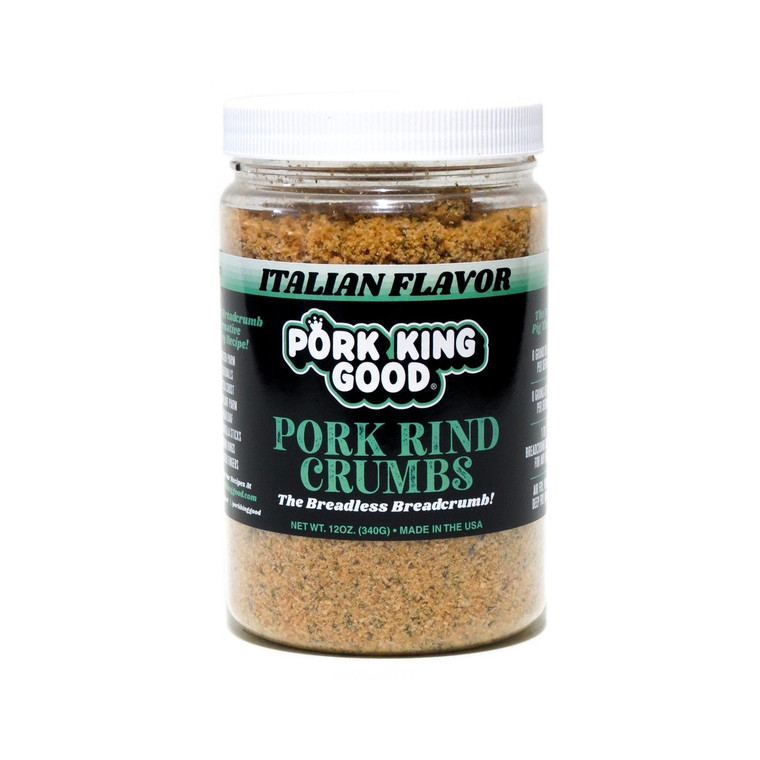
Pork King Good
Italian Pork Rind Crumbs - 12 oz
Pork King Good is the only woman-owned pork rind manufacturer in the country — a fact made official in May 2022 when the brand bought out its own supplier, the 74-year-old Porkie Company of Wisconsin, after years of being one of its biggest customers. This Italian-style crumb is what that Wisconsin plant does best: fried pork rinds ground fine and seasoned to swap 1:1 into any recipe that calls for breadcrumbs, minus the carbs.
- Coats chicken fingers and fish sticks, binds meatballs and meatloaf, and crisps up as a crust for eggplant parm, mozzarella sticks, or onion rings — anywhere a recipe calls for breadcrumbs
- Made from pork rinds cooked in the company's own rendered pork fat, seasoned Italian-style with parsley flakes and dehydrated garlic — no fillers, no wheat, no flour of any kind
- Zero-carb, keto-friendly, and naturally gluten-free — from a woman-owned Wisconsin manufacturer
Pork King Good started as a flavor-obsessed customer of The Porkie Company of Wisconsin in 2018 and grew into one of its largest accounts before buying the 74-year-old manufacturer outright in 2022 -- making it the only woman-owned pork rind manufacturing business in the U.S. This Italian-style crumb is the breadless breadcrumb the brand is known for -- a keto-friendly, gluten-free breadcrumb substitute built for Italian cooking.
Each 12 oz bag is fried pork rind, cooked in the company's own rendered pork fat, ground into a fine crumb and seasoned with salt, spices, parsley flakes, and dehydrated garlic -- the same Italian profile you'd want on a meatball or a cutlet, without a grain of wheat in it. It's built to behave exactly like traditional breadcrumbs: coat it, cook it, done.
Nutritionally, that swap matters. Traditional breadcrumbs run roughly 20g of carbohydrate per quarter-cup; this crumb carries 0g total carbohydrates per serving while adding protein instead of empty starch -- a straight upgrade for anyone tracking carbs without giving up texture.
Use it as a low-carb breading for chicken fingers, fish sticks, mozzarella sticks, and onion rings, as a binder in meatballs or meatloaf, or as a crust for pizza and eggplant parm. It browns and crisps in the oven, air fryer, or skillet the same way wheat breadcrumbs do.
Keto-compliant, gluten-free by nature (no wheat, ever touched this recipe), and shelf-stable -- store the sealed bag in a cool, dry pantry away from direct heat or sunlight to preserve crispness.
Ingredients: Pork Rinds (Cooked In Pork Fat), Salt, Spices, Parsley Flakes, and Dehydrated Garlic.
Common Questions
How does this compare nutritionally to regular Italian breadcrumbs?
A quarter-cup of traditional Italian breadcrumbs runs about 20g of carbohydrate and roughly 4g of protein, mostly from enriched wheat flour. The same serving of this crumb has 0g total carbohydrates and closer to 9-10g of protein, since it's ground fried pork rind rather than bread. You lose zero volume or coating ability in the swap — it's still a fine, absorbent crumb that holds egg wash and fries up crunchy. The tradeoff is fat content, which sits higher here because the rinds are cooked in pork fat, but for anyone counting carbs that's a straightforward win.
What's actually happening when pork rinds replace flour as a coating?
Pork rinds are essentially pre-cooked pork skin that's been fried until the collagen structure puffs and dehydrates, leaving a light, porous matrix that's almost pure protein and fat with no starch. When ground into crumb form, that same porous structure does the job flour-based breadcrumbs do: it absorbs surface moisture from egg wash and creates a crisp exterior through the Maillard reaction during cooking. Because there's no starch to gelatinize, there's no sogginess risk from excess moisture the way flour-based coatings can get gummy — it just crisps and stays crisp.
Does this fit keto, paleo, or carnivore diets?
Yes to all three, for different reasons. For keto, 0g net carbs per serving means it doesn't touch your daily carb allotment no matter how much you bread with it. For paleo, there's no grain, legume, or refined sugar in the ingredient list — just pork rinds, salt, spices, parsley, and dehydrated garlic. For strict carnivore, the parsley and garlic technically introduce plant material, so it's not a zero-plant product, but many carnivore-adjacent eaters treat small seasoning amounts like this as acceptable since the base ingredient is animal-derived pork fat and skin.
What dishes can I use this in besides basic breading?
Beyond coating chicken fingers or fish sticks, it works as a 1:1 binder in meatballs and meatloaf in place of breadcrumbs or oats, helping hold moisture without adding starch. It also makes a solid crust for baked mozzarella sticks, a topping for eggplant or chicken parmesan before it goes under the broiler, and a base layer for a low-carb pizza crust when mixed with egg and cheese. One adaptation worth knowing: because it has no starch to absorb liquid the way flour does, recipes that rely on breadcrumbs to soak up excess moisture (like a wet meatloaf mix) may need a slightly firmer hand with your binder egg.
How can I verify the ingredient and sourcing claims on this bag?
The ingredient list is short enough to check against the package directly: pork rinds cooked in pork fat, salt, spices, parsley flakes, and dehydrated garlic — nothing else. The gluten-free status isn't a marketing add-on but a structural fact, since no wheat or grain-based ingredient is used anywhere in the recipe or shared equipment history. The product carries no artificial ingredient, color, or flavor claims, which you can cross-check against the five-item ingredient panel yourself — there's nowhere for an additive to hide in a list that short.
What makes Pork King Good different from other pork rind brands?
Pork King Good owns The Porkie Company, a 74-year-old Wisconsin pork rind manufacturer it acquired outright in 2022 after years as one of its largest customers, making it the only woman-owned pork rind manufacturing business in the United States. That ownership means the company controls its own frying and grinding process rather than relabeling a co-packer's generic crumb, which is common in this category. It's also why the flavor development leans toward specific culinary profiles like this Italian blend rather than generic seasoning blends.
Is this shelf-stable, and does the fat content affect storage?
Yes, the sealed bag is shelf-stable at room temperature and doesn't require refrigeration before opening. Because the rinds are cooked in pork fat rather than a more oxidation-prone vegetable oil, and the crumb is fully dehydrated during the frying process, it holds up well in the pantry without turning rancid quickly. Once opened, keeping the bag sealed and away from direct heat or humidity will preserve the crunch factor longest, since moisture is the main thing that softens a fried product like this.
Each 12 oz bag is fried pork rind, cooked in the company's own rendered pork fat, ground into a fine crumb and seasoned with salt, spices, parsley flakes, and dehydrated garlic -- the same Italian profile you'd want on a meatball or a cutlet, without a grain of wheat in it. It's built to behave exactly like traditional breadcrumbs: coat it, cook it, done.
Nutritionally, that swap matters. Traditional breadcrumbs run roughly 20g of carbohydrate per quarter-cup; this crumb carries 0g total carbohydrates per serving while adding protein instead of empty starch -- a straight upgrade for anyone tracking carbs without giving up texture.
Use it as a low-carb breading for chicken fingers, fish sticks, mozzarella sticks, and onion rings, as a binder in meatballs or meatloaf, or as a crust for pizza and eggplant parm. It browns and crisps in the oven, air fryer, or skillet the same way wheat breadcrumbs do.
Keto-compliant, gluten-free by nature (no wheat, ever touched this recipe), and shelf-stable -- store the sealed bag in a cool, dry pantry away from direct heat or sunlight to preserve crispness.
Ingredients: Pork Rinds (Cooked In Pork Fat), Salt, Spices, Parsley Flakes, and Dehydrated Garlic.
Common Questions
How does this compare nutritionally to regular Italian breadcrumbs?
A quarter-cup of traditional Italian breadcrumbs runs about 20g of carbohydrate and roughly 4g of protein, mostly from enriched wheat flour. The same serving of this crumb has 0g total carbohydrates and closer to 9-10g of protein, since it's ground fried pork rind rather than bread. You lose zero volume or coating ability in the swap — it's still a fine, absorbent crumb that holds egg wash and fries up crunchy. The tradeoff is fat content, which sits higher here because the rinds are cooked in pork fat, but for anyone counting carbs that's a straightforward win.
What's actually happening when pork rinds replace flour as a coating?
Pork rinds are essentially pre-cooked pork skin that's been fried until the collagen structure puffs and dehydrates, leaving a light, porous matrix that's almost pure protein and fat with no starch. When ground into crumb form, that same porous structure does the job flour-based breadcrumbs do: it absorbs surface moisture from egg wash and creates a crisp exterior through the Maillard reaction during cooking. Because there's no starch to gelatinize, there's no sogginess risk from excess moisture the way flour-based coatings can get gummy — it just crisps and stays crisp.
Does this fit keto, paleo, or carnivore diets?
Yes to all three, for different reasons. For keto, 0g net carbs per serving means it doesn't touch your daily carb allotment no matter how much you bread with it. For paleo, there's no grain, legume, or refined sugar in the ingredient list — just pork rinds, salt, spices, parsley, and dehydrated garlic. For strict carnivore, the parsley and garlic technically introduce plant material, so it's not a zero-plant product, but many carnivore-adjacent eaters treat small seasoning amounts like this as acceptable since the base ingredient is animal-derived pork fat and skin.
What dishes can I use this in besides basic breading?
Beyond coating chicken fingers or fish sticks, it works as a 1:1 binder in meatballs and meatloaf in place of breadcrumbs or oats, helping hold moisture without adding starch. It also makes a solid crust for baked mozzarella sticks, a topping for eggplant or chicken parmesan before it goes under the broiler, and a base layer for a low-carb pizza crust when mixed with egg and cheese. One adaptation worth knowing: because it has no starch to absorb liquid the way flour does, recipes that rely on breadcrumbs to soak up excess moisture (like a wet meatloaf mix) may need a slightly firmer hand with your binder egg.
How can I verify the ingredient and sourcing claims on this bag?
The ingredient list is short enough to check against the package directly: pork rinds cooked in pork fat, salt, spices, parsley flakes, and dehydrated garlic — nothing else. The gluten-free status isn't a marketing add-on but a structural fact, since no wheat or grain-based ingredient is used anywhere in the recipe or shared equipment history. The product carries no artificial ingredient, color, or flavor claims, which you can cross-check against the five-item ingredient panel yourself — there's nowhere for an additive to hide in a list that short.
What makes Pork King Good different from other pork rind brands?
Pork King Good owns The Porkie Company, a 74-year-old Wisconsin pork rind manufacturer it acquired outright in 2022 after years as one of its largest customers, making it the only woman-owned pork rind manufacturing business in the United States. That ownership means the company controls its own frying and grinding process rather than relabeling a co-packer's generic crumb, which is common in this category. It's also why the flavor development leans toward specific culinary profiles like this Italian blend rather than generic seasoning blends.
Is this shelf-stable, and does the fat content affect storage?
Yes, the sealed bag is shelf-stable at room temperature and doesn't require refrigeration before opening. Because the rinds are cooked in pork fat rather than a more oxidation-prone vegetable oil, and the crumb is fully dehydrated during the frying process, it holds up well in the pantry without turning rancid quickly. Once opened, keeping the bag sealed and away from direct heat or humidity will preserve the crunch factor longest, since moisture is the main thing that softens a fried product like this.
- __Storage_Location:
- Dry
- __Volume:
- 400
- __Owner:
- Pork King Good
- __badge:
- Keto