

Original Pork Rind Crumbs - 12 oz
Pork King Good
$11.99
(No reviews yet)

Write a Review
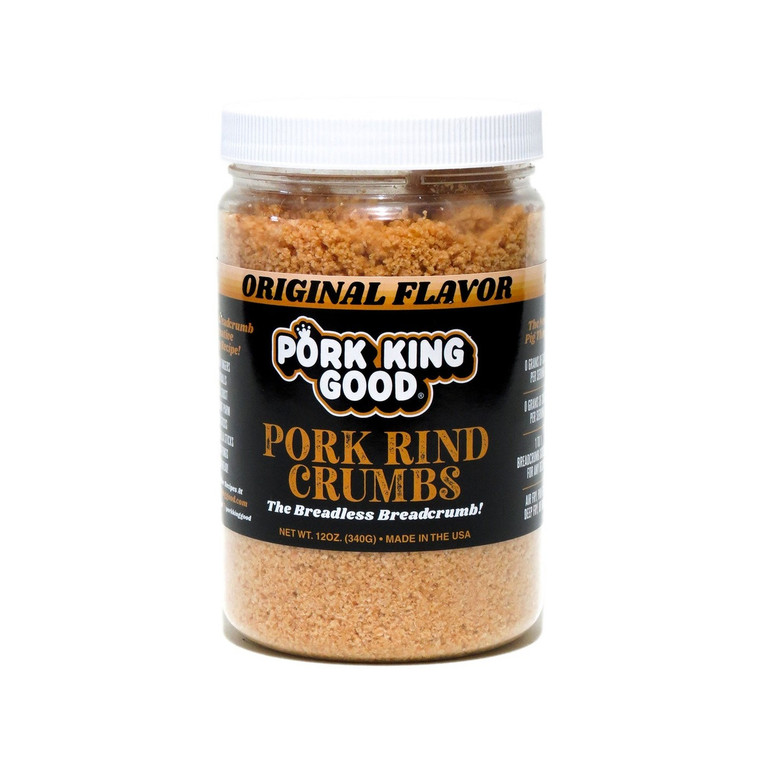
Pork King Good
Original Pork Rind Crumbs - 12 oz
Pork King Good didn't invent a new snack category — they ground down their own fried Wisconsin pork rinds until the crumb did everything a breadcrumb does, minus the wheat, minus the carbs, minus the mystery fillers. Original Pork Rind Crumbs are cooked in the company's own rendered pork fat at the 74-year-old Cudahy, Wisconsin plant Pork King Good now owns outright, then milled fine enough to bread a chicken tender, bind a meatball, or crust a fish stick with 0g total carbohydrates per serving.
- Coats, binds, and tops — swap it 1-to-1 for breadcrumbs in chicken fingers, meatballs, fish sticks, mozzarella sticks, onion rings, pizza crust, or eggplant parm.
- Milled from pork rinds cooked in the company's own pork fat, seasoned with a short list of real spices — no artificial colors or flavors, no wheat, no filler starch standing in for the crumb.
- Keto-friendly, gluten-free, and made by the only woman-owned pork rind manufacturer in the country.
Pork King Good started as a customer of a 74-year-old Wisconsin pork rind maker, got loud about flavor, and eventually just bought the plant. The Original Pork Rind Crumbs are the practical, everyday product of that takeover: the same fryers that have cooked pork rinds in Cudahy, Wisconsin (just outside Milwaukee) for generations, milled down into a keto-friendly, gluten-free breadcrumb substitute built to replace breadcrumbs, not imitate them.
Each 12 oz container is ground from pork rinds cooked in the company's own rendered pork fat, then seasoned with salt, autolyzed yeast, spices, paprika, mustard, onion powder, garlic powder, and oleoresin of paprika - a short, legible ingredient list with no artificial colors or flavors and no wheat-based fillers doing the structural work a real breadcrumb would.
The headline nutritional fact is the one that matters most if you're counting: 0g total carbohydrates per serving. A typical 1/4-cup serving of wheat breadcrumbs carries somewhere around 20g of carbohydrate; this crumb carries none, because there's no grain in it to begin with - it's fried, ground pork skin doing a grain's job. That makes it a fit not just for keto and low-carb eating, but for paleo and grain-free diets more broadly, since it's built entirely from pork and seasoning with nothing derived from wheat, corn, or other grains.
Use it exactly where a recipe calls for breadcrumbs, as a low-carb breading for coating and pan-frying, deep-frying, air-frying, baking, or grilling. It binds meatballs and meatloaf, crusts chicken fingers and fish sticks, tops a casserole, or stands in for the crust on a low-carb pizza, eggplant parmesan, or mozzarella sticks - coat it, cook it, done.
Keto-friendly, gluten-free, and made by Pork King Good - the only woman-owned pork rind manufacturer in the country, operating out of its own Cudahy, Wisconsin facility, where the pork rinds are fried and milled on-site rather than sourced out and repackaged. Store in a cool, dry pantry; reseal the container between uses to keep the crumb's texture from softening.
Ingredients: Pork Rinds (Cooked In Pork Fat), Salt, Autolyzed Yeast, Spices, Paprika, Mustard, Onion Powder, Garlic Powder, and Oleoresin Of Paprika.
Common Questions
How does this compare nutritionally to regular breadcrumbs or panko?
A quarter-cup of this pork rind crumb has 0g total carbohydrate, roughly 9-10g protein, and about 5g fat, all from ground fried pork skin. The same quarter-cup of plain wheat breadcrumbs runs about 20g carbohydrate, 3-4g protein, and less than 1g fat, and panko is similar or higher in carbs since it's made from crustless white bread. So you're trading a mostly-starch coating for a mostly-protein one: the crumb crisps and browns the same way in a pan or fryer, but it's not feeding you flour.
What does autolyzed yeast and oleoresin of paprika actually do in this product?
Autolyzed yeast is yeast broken down by its own enzymes to release free glutamates, the same compound responsible for savory depth in aged cheese or soy sauce; it's added here for umami rather than as a flavor mask, since pork rind on its own is fairly neutral once fried and ground. Oleoresin of paprika is a concentrated, oil-soluble extract of paprika pepper, used in small amounts to carry color and pepper flavor evenly through the crumb without the graininess of dry paprika powder alone. Neither is a synthetic additive; both are extracted directly from real yeast and real pepper.
Does this fit keto, paleo, and carnivore diets?
For keto, it fits cleanly: 0g net carbs per serving means it doesn't touch daily carb allowance the way even a light breadcrumb dusting would. For paleo, the ingredient list is grain-free and the seasonings are all spice-based, so it clears that bar too, though strict paleo eaters sometimes flag autolyzed yeast as a processed ingredient worth checking against personal tolerance. For carnivore, it's animal-derived at its base but includes plant-derived spices (paprika, mustard, onion and garlic powder), so it works for a looser carnivore approach but not a zero-plant-matter one.
What dishes can I substitute this into, and does the cooking method change?
Use it as a one-to-one swap anywhere a recipe calls for breadcrumbs or panko: meatballs and meatloaf as a binder, chicken tenders or fish sticks as a crust, baked mac-and-cheese or green bean casserole as a topping, and mozzarella sticks or eggplant parmesan as the breading layer. The main adjustment is heat and timing — because it's already fully cooked pork rind, you're browning and crisping it rather than cooking raw flour, so it can scorch faster under high broiler heat or in a very hot pan; medium-high heat and shorter cook times usually get the same golden crust without burning the edges.
How can I verify the sourcing and certification claims on this bag?
The pork rinds are milled at Pork King Good's own Milwaukee facility, a plant with a 74-year operating history that the company purchased outright rather than contracting out, so the sourcing chain is one step, not several. The gluten-free and keto-friendly claims are supported by the ingredient list itself, which contains no wheat, grain, or hidden starch fillers — you can cross-check every listed ingredient against the label rather than take a logo's word for it. There's no third-party gluten-free lab certification seal on this specific SKU, so if you have celiac disease rather than a general gluten sensitivity, contacting the company directly about cross-contact protocols in the Milwaukee facility is worth doing.
What does it mean that Pork King Good is woman-owned, and does that affect the product?
Pork King Good is the only woman-owned pork rind manufacturer operating in the United States, having grown from being a customer of the original Wisconsin pork rind maker into the owner of the plant itself. That ownership structure doesn't change the recipe, but it does mean production decisions, ingredient sourcing, and quality control happen under one roof rather than being outsourced to a co-packer, which is part of why the ingredient list has stayed short and recognizable across product changes.
Why is there no carbohydrate at all, when most breaded or crumbed foods carry some?
Carbohydrate in a breadcrumb comes from the wheat flour it's made of; this product has no flour or grain in it at any stage, so there's nothing to contribute starch or sugar. The crumb is entirely fried pork skin (collagen and fat that puffs and crisps under heat) ground down to a breadcrumb-sized texture, then dry-seasoned. That's a structural substitution, not a stripped-down or reformulated one — it's simply a different raw material doing the same textural job flour normally does.
Each 12 oz container is ground from pork rinds cooked in the company's own rendered pork fat, then seasoned with salt, autolyzed yeast, spices, paprika, mustard, onion powder, garlic powder, and oleoresin of paprika - a short, legible ingredient list with no artificial colors or flavors and no wheat-based fillers doing the structural work a real breadcrumb would.
The headline nutritional fact is the one that matters most if you're counting: 0g total carbohydrates per serving. A typical 1/4-cup serving of wheat breadcrumbs carries somewhere around 20g of carbohydrate; this crumb carries none, because there's no grain in it to begin with - it's fried, ground pork skin doing a grain's job. That makes it a fit not just for keto and low-carb eating, but for paleo and grain-free diets more broadly, since it's built entirely from pork and seasoning with nothing derived from wheat, corn, or other grains.
Use it exactly where a recipe calls for breadcrumbs, as a low-carb breading for coating and pan-frying, deep-frying, air-frying, baking, or grilling. It binds meatballs and meatloaf, crusts chicken fingers and fish sticks, tops a casserole, or stands in for the crust on a low-carb pizza, eggplant parmesan, or mozzarella sticks - coat it, cook it, done.
Keto-friendly, gluten-free, and made by Pork King Good - the only woman-owned pork rind manufacturer in the country, operating out of its own Cudahy, Wisconsin facility, where the pork rinds are fried and milled on-site rather than sourced out and repackaged. Store in a cool, dry pantry; reseal the container between uses to keep the crumb's texture from softening.
Ingredients: Pork Rinds (Cooked In Pork Fat), Salt, Autolyzed Yeast, Spices, Paprika, Mustard, Onion Powder, Garlic Powder, and Oleoresin Of Paprika.
Common Questions
How does this compare nutritionally to regular breadcrumbs or panko?
A quarter-cup of this pork rind crumb has 0g total carbohydrate, roughly 9-10g protein, and about 5g fat, all from ground fried pork skin. The same quarter-cup of plain wheat breadcrumbs runs about 20g carbohydrate, 3-4g protein, and less than 1g fat, and panko is similar or higher in carbs since it's made from crustless white bread. So you're trading a mostly-starch coating for a mostly-protein one: the crumb crisps and browns the same way in a pan or fryer, but it's not feeding you flour.
What does autolyzed yeast and oleoresin of paprika actually do in this product?
Autolyzed yeast is yeast broken down by its own enzymes to release free glutamates, the same compound responsible for savory depth in aged cheese or soy sauce; it's added here for umami rather than as a flavor mask, since pork rind on its own is fairly neutral once fried and ground. Oleoresin of paprika is a concentrated, oil-soluble extract of paprika pepper, used in small amounts to carry color and pepper flavor evenly through the crumb without the graininess of dry paprika powder alone. Neither is a synthetic additive; both are extracted directly from real yeast and real pepper.
Does this fit keto, paleo, and carnivore diets?
For keto, it fits cleanly: 0g net carbs per serving means it doesn't touch daily carb allowance the way even a light breadcrumb dusting would. For paleo, the ingredient list is grain-free and the seasonings are all spice-based, so it clears that bar too, though strict paleo eaters sometimes flag autolyzed yeast as a processed ingredient worth checking against personal tolerance. For carnivore, it's animal-derived at its base but includes plant-derived spices (paprika, mustard, onion and garlic powder), so it works for a looser carnivore approach but not a zero-plant-matter one.
What dishes can I substitute this into, and does the cooking method change?
Use it as a one-to-one swap anywhere a recipe calls for breadcrumbs or panko: meatballs and meatloaf as a binder, chicken tenders or fish sticks as a crust, baked mac-and-cheese or green bean casserole as a topping, and mozzarella sticks or eggplant parmesan as the breading layer. The main adjustment is heat and timing — because it's already fully cooked pork rind, you're browning and crisping it rather than cooking raw flour, so it can scorch faster under high broiler heat or in a very hot pan; medium-high heat and shorter cook times usually get the same golden crust without burning the edges.
How can I verify the sourcing and certification claims on this bag?
The pork rinds are milled at Pork King Good's own Milwaukee facility, a plant with a 74-year operating history that the company purchased outright rather than contracting out, so the sourcing chain is one step, not several. The gluten-free and keto-friendly claims are supported by the ingredient list itself, which contains no wheat, grain, or hidden starch fillers — you can cross-check every listed ingredient against the label rather than take a logo's word for it. There's no third-party gluten-free lab certification seal on this specific SKU, so if you have celiac disease rather than a general gluten sensitivity, contacting the company directly about cross-contact protocols in the Milwaukee facility is worth doing.
What does it mean that Pork King Good is woman-owned, and does that affect the product?
Pork King Good is the only woman-owned pork rind manufacturer operating in the United States, having grown from being a customer of the original Wisconsin pork rind maker into the owner of the plant itself. That ownership structure doesn't change the recipe, but it does mean production decisions, ingredient sourcing, and quality control happen under one roof rather than being outsourced to a co-packer, which is part of why the ingredient list has stayed short and recognizable across product changes.
Why is there no carbohydrate at all, when most breaded or crumbed foods carry some?
Carbohydrate in a breadcrumb comes from the wheat flour it's made of; this product has no flour or grain in it at any stage, so there's nothing to contribute starch or sugar. The crumb is entirely fried pork skin (collagen and fat that puffs and crisps under heat) ground down to a breadcrumb-sized texture, then dry-seasoned. That's a structural substitution, not a stripped-down or reformulated one — it's simply a different raw material doing the same textural job flour normally does.
- __Storage_Location:
- Dry
- __Volume:
- 400
- __Owner:
- Pork King Good
- __badge:
- Keto