

Smoked Bloody Mary Rimmer and Mix - 6 oz
Double D BBQ
$10.00
(No reviews yet)

Write a Review
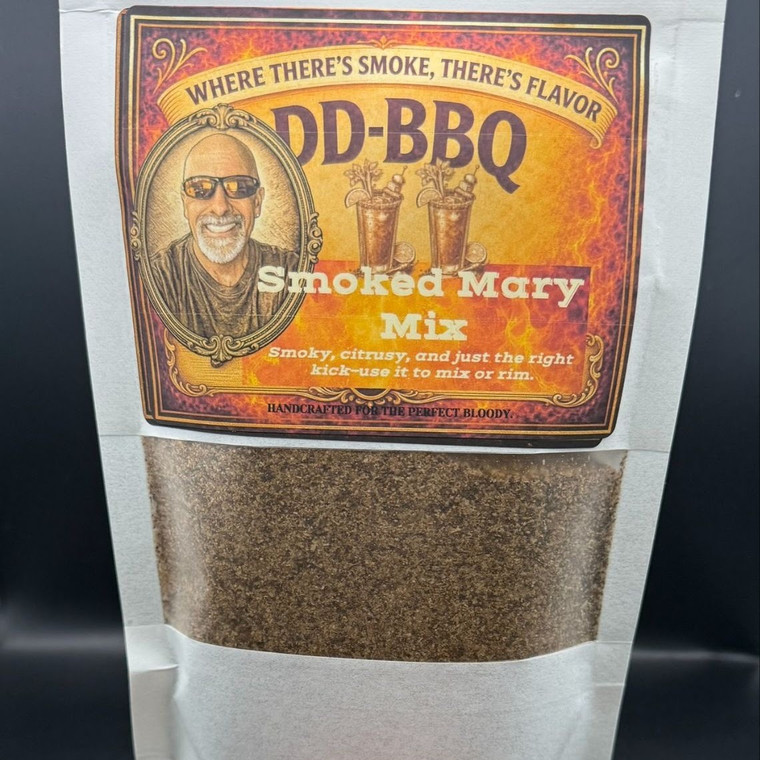
Double D BBQ
Smoked Bloody Mary Rimmer and Mix - 6 oz
Smoked Mary was built by starting with the brand's own Kiss of SPOG base — salt, pepper, onion, and garlic — then layering in smoked salt, celery salt, and cayenne until the balance was right for a proper Bloody Mary. Every batch is mixed by hand in a Minnesota kitchen, in small runs, using locally sourced ingredients rather than a warehouse formula.
- Rim the glass, stir it into tomato juice, or do both for a Bloody Mary that leans smoky and savory instead of one-note salty.
- Built from a four-ingredient foundation and hand-mixed in small Minnesota batches — not a mass-produced cocktail powder.
- Free of wheat, dairy, and soy ingredients, so it drops cleanly into gluten-free and dairy-free brunch spreads.
Double D BBQ didn't set out to build a cocktail seasoning — Smoked Mary, this smoky Bloody Mary seasoning, grew out of the brand's Kiss of SPOG blend, the salt-pepper-onion-garlic base that anchors most of what comes out of the kitchen. Smoked salt, celery salt, and cayenne were added until it hit the smoky, savory profile a good Bloody Mary deserves.
This rimmer-and-mix is coarse enough to catch on a wet glass rim, balanced enough to stir straight into tomato juice. Like every Double D BBQ product, it's mixed by hand in small batches in a Minnesota kitchen — the same ingredients that season the maker's own table, not a bulk-produced formula.
For a brunch spread, rim the glass with a wet lime edge and a shallow dish of Smoked Mary, then stir a spoonful into the tomato juice itself for a Bloody Mary that's bold and smoky from the first sip. Because it shares its salt-pepper-onion-garlic backbone with the rest of the lineup, a light sprinkle also works as a smoky finishing salt on savory snacks when a cocktail isn't on the menu.
Store the jar sealed in a cool, dry pantry — no refrigeration needed, and it'll hold its smoky punch for months on the shelf. With no wheat, dairy, or soy in the ingredient list, it fits cleanly into gluten-free and dairy-free brunch tables alike. Ingredients: Salt, Pepper, Onion Powder, Garlic Powder, Celery Salt, Paprika, Lime Powder, Sugar, Cayenne, and Spices.
Common Questions
How does Smoked Mary compare to a typical grocery-store Bloody Mary rimmer or seasoning packet?
Most bagged rimming salts are just coarse salt with red dye and citric acid, and most Bloody Mary seasoning packets lean on MSG, silicon dioxide anti-caking agents, and dehydrated tomato powder to bulk out the jar cheaply. Smoked Mary's ingredient list is ten items long — salt, pepper, onion powder, garlic powder, celery salt, paprika, lime powder, sugar, cayenne, and spices — with no fillers, gums, or artificial color. Because it's mixed in small batches rather than run through industrial blending equipment, the coarse salt crystals stay intact for rimming instead of being crushed into fine dust during high-volume processing. The tradeoff is shelf count: this is a single 6 oz jar, not a pallet-scale product, so batches are limited by kitchen capacity rather than a factory line.
What does the sodium and capsaicin actually do in this blend besides add flavor?
Salt and celery salt are the base of the blend, and sodium is what makes a Bloody Mary taste balanced rather than flat — tomato juice is naturally low in sodium relative to its acid and sugar content, so the rim and the stir-in both correct that gap. Cayenne contributes capsaicin, the compound responsible for the back-of-throat heat; capsaicin also stimulates saliva production, which is part of why a spicy Bloody Mary reads as more refreshing than a bland one. Smoked salt (rather than liquid smoke) delivers the smoky note through actual wood-smoke-infused crystals, so the smoke flavor is carried by the salt itself rather than a liquid additive. Paprika adds color and a mild vegetal sweetness without meaningfully adding heat, since most cayenne varieties carry roughly 30,000 to 50,000 Scoville units while sweet paprika sits near zero.
Does this fit a keto, paleo, or carnivore way of eating?
A quarter-teaspoon serving is almost entirely salt and dried aromatics, so the carbohydrate contribution is negligible — well under 1 gram per serving even with the small amount of sugar in the ingredient list, which is there to round out the cayenne's heat rather than to sweeten the blend. That makes it compatible with keto and low-carb Bloody Mary builds as long as you're also watching the tomato juice, which carries its own natural sugars. For paleo, the ingredient list is clean of grains, dairy, and refined additives, though strict paleo eaters sometimes flag cane sugar in any amount — here it's a minor component, not a primary ingredient. Carnivore-style eaters typically skip tomato-based cocktails entirely, but the seasoning itself has no animal-derived ingredients and works fine as a dry rub on meat if that's the use case.
Can I use Smoked Mary for anything besides a Bloody Mary?
Yes — because it shares the salt-pepper-onion-garlic backbone with the rest of the Double D BBQ lineup, it works as a smoked finishing salt on grilled corn, deviled eggs, or a charcuterie board when you want savory heat without reaching for a full spice rub. It's also a solid dry rub addition for grilled shrimp or chicken wings: pat the protein dry, sprinkle a light coat before grilling, and skip additional salt elsewhere in the recipe since this blend is salt-forward. For a Bloody Mary mocktail or virgin version, the seasoning performs identically since none of its flavor depends on alcohol. If using it as a snack seasoning rather than a rimmer, start with a lighter hand than you would for the cocktail rim — the coarse crystals are calibrated for a wet glass edge, which uses more product per application than a sprinkle on food.
How can I verify the small-batch and Minnesota-made claims?
Double D BBQ is registered under Minnesota's Cottage Food Producer Law, which permits home-kitchen food production for direct sale but caps annual sales and requires the producer to operate out of a single registered kitchen — it's a state-level framework, not a third-party certification, so the verification is the registration itself rather than a logo or seal. Dennis Daily mixes each batch by hand in that kitchen, which is why batch sizes are limited by what one person can physically produce rather than run through commercial equipment. There's no gluten, dairy, or soy in the ingredient list, which is a straightforward ingredient-label fact you can confirm yourself rather than a certified allergen claim. If you want lot-level traceability, small-batch producers under cottage food law typically date or number jars by batch, so check the jar itself for that detail.
Why does a Bloody Mary seasoning need to be coarse rather than fine?
Fine salt dissolves into a wet glass rim almost instantly and washes off within a sip or two, while coarse salt crystals hold their structure and stay adhered to the glass edge through most of the drink. That's a physical property of crystal size, not a flavor difference — the same blend ground fine would taste identical but perform worse as a rim. Coarse grinding also matters for the stir-in use: because the crystals dissolve more slowly than fine salt, stirring a spoonful directly into tomato juice releases flavor gradually rather than dumping all the sodium in at once, which is part of why the same jar works for both applications without needing two separate products.
This rimmer-and-mix is coarse enough to catch on a wet glass rim, balanced enough to stir straight into tomato juice. Like every Double D BBQ product, it's mixed by hand in small batches in a Minnesota kitchen — the same ingredients that season the maker's own table, not a bulk-produced formula.
For a brunch spread, rim the glass with a wet lime edge and a shallow dish of Smoked Mary, then stir a spoonful into the tomato juice itself for a Bloody Mary that's bold and smoky from the first sip. Because it shares its salt-pepper-onion-garlic backbone with the rest of the lineup, a light sprinkle also works as a smoky finishing salt on savory snacks when a cocktail isn't on the menu.
Store the jar sealed in a cool, dry pantry — no refrigeration needed, and it'll hold its smoky punch for months on the shelf. With no wheat, dairy, or soy in the ingredient list, it fits cleanly into gluten-free and dairy-free brunch tables alike. Ingredients: Salt, Pepper, Onion Powder, Garlic Powder, Celery Salt, Paprika, Lime Powder, Sugar, Cayenne, and Spices.
Common Questions
How does Smoked Mary compare to a typical grocery-store Bloody Mary rimmer or seasoning packet?
Most bagged rimming salts are just coarse salt with red dye and citric acid, and most Bloody Mary seasoning packets lean on MSG, silicon dioxide anti-caking agents, and dehydrated tomato powder to bulk out the jar cheaply. Smoked Mary's ingredient list is ten items long — salt, pepper, onion powder, garlic powder, celery salt, paprika, lime powder, sugar, cayenne, and spices — with no fillers, gums, or artificial color. Because it's mixed in small batches rather than run through industrial blending equipment, the coarse salt crystals stay intact for rimming instead of being crushed into fine dust during high-volume processing. The tradeoff is shelf count: this is a single 6 oz jar, not a pallet-scale product, so batches are limited by kitchen capacity rather than a factory line.
What does the sodium and capsaicin actually do in this blend besides add flavor?
Salt and celery salt are the base of the blend, and sodium is what makes a Bloody Mary taste balanced rather than flat — tomato juice is naturally low in sodium relative to its acid and sugar content, so the rim and the stir-in both correct that gap. Cayenne contributes capsaicin, the compound responsible for the back-of-throat heat; capsaicin also stimulates saliva production, which is part of why a spicy Bloody Mary reads as more refreshing than a bland one. Smoked salt (rather than liquid smoke) delivers the smoky note through actual wood-smoke-infused crystals, so the smoke flavor is carried by the salt itself rather than a liquid additive. Paprika adds color and a mild vegetal sweetness without meaningfully adding heat, since most cayenne varieties carry roughly 30,000 to 50,000 Scoville units while sweet paprika sits near zero.
Does this fit a keto, paleo, or carnivore way of eating?
A quarter-teaspoon serving is almost entirely salt and dried aromatics, so the carbohydrate contribution is negligible — well under 1 gram per serving even with the small amount of sugar in the ingredient list, which is there to round out the cayenne's heat rather than to sweeten the blend. That makes it compatible with keto and low-carb Bloody Mary builds as long as you're also watching the tomato juice, which carries its own natural sugars. For paleo, the ingredient list is clean of grains, dairy, and refined additives, though strict paleo eaters sometimes flag cane sugar in any amount — here it's a minor component, not a primary ingredient. Carnivore-style eaters typically skip tomato-based cocktails entirely, but the seasoning itself has no animal-derived ingredients and works fine as a dry rub on meat if that's the use case.
Can I use Smoked Mary for anything besides a Bloody Mary?
Yes — because it shares the salt-pepper-onion-garlic backbone with the rest of the Double D BBQ lineup, it works as a smoked finishing salt on grilled corn, deviled eggs, or a charcuterie board when you want savory heat without reaching for a full spice rub. It's also a solid dry rub addition for grilled shrimp or chicken wings: pat the protein dry, sprinkle a light coat before grilling, and skip additional salt elsewhere in the recipe since this blend is salt-forward. For a Bloody Mary mocktail or virgin version, the seasoning performs identically since none of its flavor depends on alcohol. If using it as a snack seasoning rather than a rimmer, start with a lighter hand than you would for the cocktail rim — the coarse crystals are calibrated for a wet glass edge, which uses more product per application than a sprinkle on food.
How can I verify the small-batch and Minnesota-made claims?
Double D BBQ is registered under Minnesota's Cottage Food Producer Law, which permits home-kitchen food production for direct sale but caps annual sales and requires the producer to operate out of a single registered kitchen — it's a state-level framework, not a third-party certification, so the verification is the registration itself rather than a logo or seal. Dennis Daily mixes each batch by hand in that kitchen, which is why batch sizes are limited by what one person can physically produce rather than run through commercial equipment. There's no gluten, dairy, or soy in the ingredient list, which is a straightforward ingredient-label fact you can confirm yourself rather than a certified allergen claim. If you want lot-level traceability, small-batch producers under cottage food law typically date or number jars by batch, so check the jar itself for that detail.
Why does a Bloody Mary seasoning need to be coarse rather than fine?
Fine salt dissolves into a wet glass rim almost instantly and washes off within a sip or two, while coarse salt crystals hold their structure and stay adhered to the glass edge through most of the drink. That's a physical property of crystal size, not a flavor difference — the same blend ground fine would taste identical but perform worse as a rim. Coarse grinding also matters for the stir-in use: because the crystals dissolve more slowly than fine salt, stirring a spoonful directly into tomato juice releases flavor gradually rather than dumping all the sodium in at once, which is part of why the same jar works for both applications without needing two separate products.
- __Storage_Location:
- Dry
- __Volume:
- 300
- __Owner:
- Double D BBQ
- __badge:
- Locally Sourced