

Unseasoned Pork Rind Crumbs - 12 oz
Pork King Good
$11.99
(No reviews yet)

Write a Review
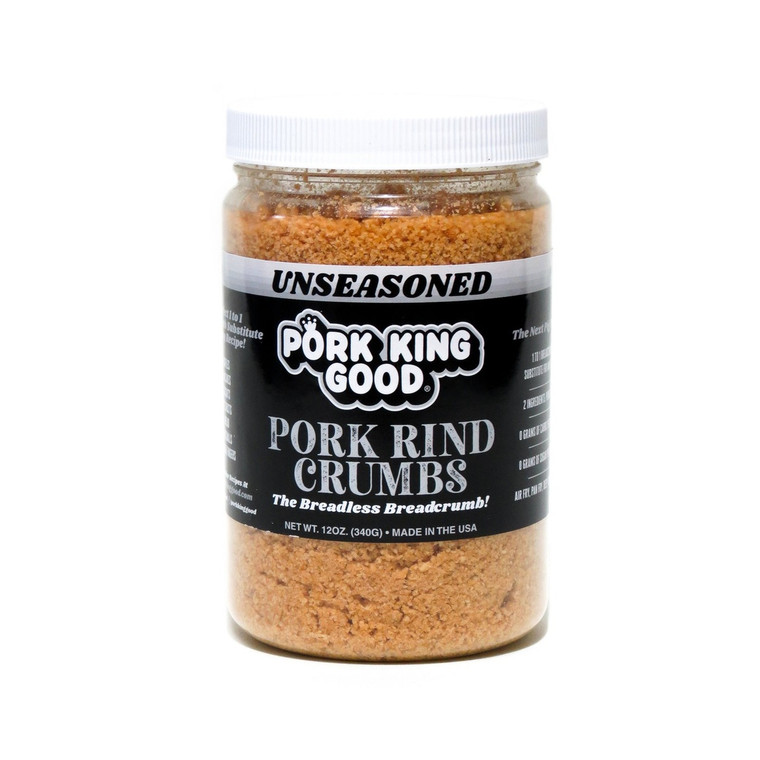
Pork King Good
Unseasoned Pork Rind Crumbs - 12 oz
This is what happens when a pork rind company decides breadcrumbs need a rework: finely milled crumbs that pack into meatballs, coat a cutlet, or top a casserole exactly like panko does — minus every gram of carbohydrate. Pork King Good grinds these down at the 74-year-old Wisconsin plant it now owns outright, cooking the rinds in its own rendered pork fat rather than buying pre-fried stock. The company that makes them is the only woman-owned pork rind manufacturer in the country, and it shows in a product built to do a real job in your kitchen, not just sit in a snack bag.
- A 1-for-1 swap for breadcrumbs or panko in meatballs, chicken parm, casserole toppings, or as a dredge for pan-frying — zero-carb crunch, same technique you already know.
- Made from pork rinds cooked in their own rendered pork fat at the same Wisconsin facility that's been running since 1948, so the crumb texture is controlled at the source instead of outsourced.
- Keto, gluten-free, and unseasoned by design — a blank canvas that takes on whatever seasoning your recipe calls for instead of fighting it.
Pork King Good didn't invent a snack aisle gimmick - it re-engineered the pork rind into a pantry staple. These are the unseasoned pork rind crumbs: milled fine, holding zero total carbohydrates per serving, and built specifically to replace breadcrumbs or panko anywhere your recipe calls for a bind or a coating.
Each package comes from a company that started in 2018 as a customer of The Porkie Company of Wisconsin, grew into one of that manufacturer's biggest accounts on the strength of its flavor lineup, and then bought the whole operation in May 2022 - making Pork King Good the only woman-owned pork rind manufacturer in the U.S. The unseasoned crumbs are cooked in the company's own rendered pork fat, not a third-party frying line, sourced and produced at that same Wisconsin facility, which keeps the ingredient list to exactly two things.
Use them where you'd normally reach for panko or Italian breadcrumbs: bind meatballs and meatloaf, coat chicken or pork cutlets before pan-frying, top a baked mac and cheese or green bean casserole, or fold into a low-carb stuffing. Because they're unseasoned, they take on garlic, herbs, parmesan, or whatever your recipe already calls for instead of layering in a competing flavor.
Keto and gluten-free by ingredient list, with 0g total carbohydrates per serving, and since the only ingredients are pork rinds and salt, they fit paleo and carnivore ways of eating as well. Store in a cool, dry pantry and reseal after opening to keep the crumb texture from softening.
Ingredients: Pork Rinds (Cooked in Pork Fat) and Salt.
Common Questions
How do these pork rind crumbs compare nutritionally to regular breadcrumbs or panko?
A typical 1-ounce serving of Italian breadcrumbs runs about 22g of total carbohydrates and 4g of protein, while the same serving of panko is close to 20g of carbs and 3g of protein. Pork King Good's unseasoned crumbs have 0g total carbohydrates per serving and roughly 17g of protein, with the remainder coming from fat rendered during the frying process. That means swapping a cup of panko for a cup of these crumbs in a coating or binding recipe removes somewhere around 80-90g of carbohydrate from the dish while adding significant protein. The tradeoff is that pork rind crumbs don't brown or crisp identically to wheat-based crumbs because there's no starch to gelatinize, so coated proteins come out more deeply golden and slightly denser rather than airy-crisp.
Why do pork rind crumbs work as a binder in meatballs and meatloaf the same way breadcrumbs do?
Breadcrumbs bind ground meat mixtures by absorbing liquid (milk, egg, stock) and swelling with starch, which holds the matrix together as it cooks. Pork rinds don't contain starch, but they're almost entirely collagen-derived protein that has already been cooked and dehydrated during the rendering process, so when milled into crumbs they rehydrate quickly and act as a protein sponge instead of a starch sponge. The result is a similar mechanical binding effect - the crumb particles swell with egg or moisture and lock the meat mixture together - without introducing any carbohydrate. Because they're already fully cooked, they also add zero raw-starch texture, so recipes tend to need slightly less liquid than a breadcrumb version to avoid an overly soft bind.
Do these fit keto, paleo, and carnivore diets?
Yes, on macros alone: 0g total carbohydrates per serving, roughly 17g of protein, and the balance in fat makes this compatible with the macro ratios required for ketosis, since carbohydrate is the variable most keto protocols restrict to under 20-50g daily. For paleo, the ingredient list of pork rinds and salt contains no legumes, grains, dairy, or refined sugar, which satisfies most paleo frameworks. Strict carnivore followers who allow only animal-based foods will find this compliant as well, since it's pork and salt with no plant-derived starches, gums, or fillers used as anti-caking agents in some competing brands. The main variable to check against your specific protocol is sodium content per serving if you're tracking that separately.
What dishes can I substitute these into, and does the cooking method need to change?
Use them as a 1:1 volume substitute for panko or dried breadcrumbs in meatloaf, meatballs, crab cakes, stuffed peppers, or as a binder in burger patties. For coating chicken cutlets, pork chops, or fish before pan-frying or baking, press the crumbs on the same way you would breadcrumbs, but expect a faster browning time since there's no starch that needs prolonged heat to gelatinize - check for doneness a few minutes earlier than your usual recipe timing. As a casserole or gratin topping (mac and cheese, green bean casserole), they crisp up under a broiler in about half the time panko takes, so watch them closely rather than walking away. One adjustment worth noting: because pork rind crumbs don't absorb oil the way starch-based crumbs do, fried applications may need slightly less oil in the pan to avoid excess greasiness.
How can I verify the ingredient and sourcing claims on this product?
The ingredient panel lists exactly two items - pork rinds cooked in pork fat, and salt - which you can check against the packaging directly; there are no hidden starches, gums, or flavor carriers that would need to be disclosed separately. The product carries third-party-recognized claims including Gluten-Free, Keto Friendly, and No Artificial Ingredients, Colors or Flavors, which are standard label certifications you can cross-reference against the manufacturer's ingredient statement. Pork King Good owns its production outright, having purchased The Porkie Company of Wisconsin's manufacturing operation in May 2022 after years as one of that facility's largest customers, so the frying and rendering happen in-house rather than through a co-packer with variable sourcing. That kind of vertical integration is why the fat used to cook the rinds is their own rendered pork fat rather than a third-party frying oil blend.
What does it mean that Pork King Good is woman-owned, and does that affect the product itself?
Pork King Good is the only woman-owned pork rind manufacturer in the United States, a distinction that dates to the company's 2022 acquisition of its former co-packer, The Porkie Company of Wisconsin. Practically, that ownership structure is what allowed the company to move from being a customer placing orders to controlling the entire production line, including the pork fat rendering and the milling process that turns whole rinds into fine crumbs. It doesn't change the ingredient list, but it does mean quality control, batch consistency, and ingredient sourcing decisions are made in-house rather than dictated by a separate manufacturing partner with its own priorities. For buyers who track supply chain ownership as part of their purchasing decisions, this is a verifiable, named acquisition rather than a marketing label.
Each package comes from a company that started in 2018 as a customer of The Porkie Company of Wisconsin, grew into one of that manufacturer's biggest accounts on the strength of its flavor lineup, and then bought the whole operation in May 2022 - making Pork King Good the only woman-owned pork rind manufacturer in the U.S. The unseasoned crumbs are cooked in the company's own rendered pork fat, not a third-party frying line, sourced and produced at that same Wisconsin facility, which keeps the ingredient list to exactly two things.
Use them where you'd normally reach for panko or Italian breadcrumbs: bind meatballs and meatloaf, coat chicken or pork cutlets before pan-frying, top a baked mac and cheese or green bean casserole, or fold into a low-carb stuffing. Because they're unseasoned, they take on garlic, herbs, parmesan, or whatever your recipe already calls for instead of layering in a competing flavor.
Keto and gluten-free by ingredient list, with 0g total carbohydrates per serving, and since the only ingredients are pork rinds and salt, they fit paleo and carnivore ways of eating as well. Store in a cool, dry pantry and reseal after opening to keep the crumb texture from softening.
Ingredients: Pork Rinds (Cooked in Pork Fat) and Salt.
Common Questions
How do these pork rind crumbs compare nutritionally to regular breadcrumbs or panko?
A typical 1-ounce serving of Italian breadcrumbs runs about 22g of total carbohydrates and 4g of protein, while the same serving of panko is close to 20g of carbs and 3g of protein. Pork King Good's unseasoned crumbs have 0g total carbohydrates per serving and roughly 17g of protein, with the remainder coming from fat rendered during the frying process. That means swapping a cup of panko for a cup of these crumbs in a coating or binding recipe removes somewhere around 80-90g of carbohydrate from the dish while adding significant protein. The tradeoff is that pork rind crumbs don't brown or crisp identically to wheat-based crumbs because there's no starch to gelatinize, so coated proteins come out more deeply golden and slightly denser rather than airy-crisp.
Why do pork rind crumbs work as a binder in meatballs and meatloaf the same way breadcrumbs do?
Breadcrumbs bind ground meat mixtures by absorbing liquid (milk, egg, stock) and swelling with starch, which holds the matrix together as it cooks. Pork rinds don't contain starch, but they're almost entirely collagen-derived protein that has already been cooked and dehydrated during the rendering process, so when milled into crumbs they rehydrate quickly and act as a protein sponge instead of a starch sponge. The result is a similar mechanical binding effect - the crumb particles swell with egg or moisture and lock the meat mixture together - without introducing any carbohydrate. Because they're already fully cooked, they also add zero raw-starch texture, so recipes tend to need slightly less liquid than a breadcrumb version to avoid an overly soft bind.
Do these fit keto, paleo, and carnivore diets?
Yes, on macros alone: 0g total carbohydrates per serving, roughly 17g of protein, and the balance in fat makes this compatible with the macro ratios required for ketosis, since carbohydrate is the variable most keto protocols restrict to under 20-50g daily. For paleo, the ingredient list of pork rinds and salt contains no legumes, grains, dairy, or refined sugar, which satisfies most paleo frameworks. Strict carnivore followers who allow only animal-based foods will find this compliant as well, since it's pork and salt with no plant-derived starches, gums, or fillers used as anti-caking agents in some competing brands. The main variable to check against your specific protocol is sodium content per serving if you're tracking that separately.
What dishes can I substitute these into, and does the cooking method need to change?
Use them as a 1:1 volume substitute for panko or dried breadcrumbs in meatloaf, meatballs, crab cakes, stuffed peppers, or as a binder in burger patties. For coating chicken cutlets, pork chops, or fish before pan-frying or baking, press the crumbs on the same way you would breadcrumbs, but expect a faster browning time since there's no starch that needs prolonged heat to gelatinize - check for doneness a few minutes earlier than your usual recipe timing. As a casserole or gratin topping (mac and cheese, green bean casserole), they crisp up under a broiler in about half the time panko takes, so watch them closely rather than walking away. One adjustment worth noting: because pork rind crumbs don't absorb oil the way starch-based crumbs do, fried applications may need slightly less oil in the pan to avoid excess greasiness.
How can I verify the ingredient and sourcing claims on this product?
The ingredient panel lists exactly two items - pork rinds cooked in pork fat, and salt - which you can check against the packaging directly; there are no hidden starches, gums, or flavor carriers that would need to be disclosed separately. The product carries third-party-recognized claims including Gluten-Free, Keto Friendly, and No Artificial Ingredients, Colors or Flavors, which are standard label certifications you can cross-reference against the manufacturer's ingredient statement. Pork King Good owns its production outright, having purchased The Porkie Company of Wisconsin's manufacturing operation in May 2022 after years as one of that facility's largest customers, so the frying and rendering happen in-house rather than through a co-packer with variable sourcing. That kind of vertical integration is why the fat used to cook the rinds is their own rendered pork fat rather than a third-party frying oil blend.
What does it mean that Pork King Good is woman-owned, and does that affect the product itself?
Pork King Good is the only woman-owned pork rind manufacturer in the United States, a distinction that dates to the company's 2022 acquisition of its former co-packer, The Porkie Company of Wisconsin. Practically, that ownership structure is what allowed the company to move from being a customer placing orders to controlling the entire production line, including the pork fat rendering and the milling process that turns whole rinds into fine crumbs. It doesn't change the ingredient list, but it does mean quality control, batch consistency, and ingredient sourcing decisions are made in-house rather than dictated by a separate manufacturing partner with its own priorities. For buyers who track supply chain ownership as part of their purchasing decisions, this is a verifiable, named acquisition rather than a marketing label.
- __Storage_Location:
- Dry
- __Volume:
- 400
- __Owner:
- Pork King Good
- __badge:
- Keto